Category: Home Projects

Home Projects to Repair or Improve

  • Shaker Kitchen Cabinet Update – Painting the doors and drawers

    Shaker Kitchen Cabinet Update – Painting the doors and drawers

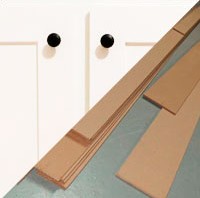
    Finally. It took almost 2 weeks for me to get all the MDF strips done. I was working in the basement and the cool temperatures made the drying time for the Liquid Nails take forever.

    I had stumbled across the original post where the paint choice and instructions had come from at Ask the Paint Gurus http://paintgurus.typepad.com/blog/2011/01/the-right-way-to-re-finish-kitchen-cabinets.html. It’s a Benjamin Moore site. It’s a good write-up and I’d recommend a read for anyone planning to paint their cabinets.

    Shaker Kitchen Cabinet Update - Painting the doors and drawers - TheDIYGirl.com
    Using an old door as a work table along with my cutting table

    Set up

    I had saved a wooden door (I replaced a wood interior door that led to the garage with a steel door and dead bolt) for a large work surface and also used a cutting table I have for sewing. I have a room full of doors. The drawer fronts were in the bedroom to the side. I had to remove the drawer glides from the bottom so they would sit flat for painting.

    The backs were already sanded so I just needed to wipe them down before painting.

    I wanted to start with the backs to iron out any painting problems I might run into before doing the more visible fronts.

    Priming

    Shaker Kitchen Cabinet Update - Painting the doors and drawers - TheDIYGirl.com
    Primed on right and first coat of paint on left

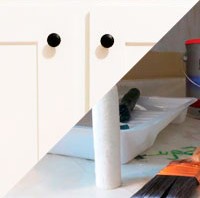
    I’m using the Fresh Start primer from Benjamin Moore and a wool roller to apply to primer. I primed the 3/8″ inset with a foam brush and rolled the backs applying only a very thin, but thorough coat of primer using the lightest touch possible with the roller.

    The point of primer here is to provide a good adhesion surface between the door and the new paint. The purpose isn’t to blot out any sign of the former color. 2 coats of primer to completely cover the previous color is a waste of time. One well applied coat is all that’s needed.

    When all was said and done I thought it looked a little blotchy from the roller tufts and was worried the blotches would translate to lumpy when it dried. It smoothed out fairly well when dry, but I threw out the roller. I didn’t want to risk a lumpy appearance with the paint.

    I sanded the primer with a 320 sanding block and wiped the sanding dust off with a rag dipped in mineral spirits. The doors felt smooth to the touch.

    Two coats of paint

    Shaker Kitchen Cabinet Update - Painting the doors and drawers - TheDIYGirl.com
    Doors with second coat of paint

    I switched to a different roller and still thought the paint looked a little lumpy after rolling, but this paint is incredible — it levels as it dries and by the time it had dried a few hours the alkyd paint looked really good.

    Since I was working on the backs of the doors I wanted to experiment a little before doing the fronts. After rereading http://paintgurus.typepad.com/blog/2011/01/the-right-way-to-re-finish-kitchen-cabinets.html I decided to try rolling and then doing a final full length brush strokes all the way across each door (what they call back brushing) . I had basically back rolled each door on the first coat after getting the initial coverage I did slightly overlapping strokes the full length of the doors.

    So far I think the back rolling with the roller gave better results than the back brushing after rolling. The doors have only been drying for 5 hours, so I’ll see how they look in the morning.

    Drying time

    Drying time is an issue with Benjamin Moore’s Advance paint. Since it’s an alkyd paint the standard drying time is 16 hours. Add cool temperatures and humidity and that drying time will be longer. 

    I let the doors dry for 2 days before flipping them over to do the fronts. I wanted the paint to be really dry so it wouldn’t stick to the wood blocks I set them on. I do not want paint to pull off when I lift the doors off the blocks.

    I the doors and drawers dry for a week before hanging/replacing them since I’m working on them in a cool basement, I want to make very sure they are thoroughly dry before handling them.
     

  • Shaker Kitchen Cabinet Update – applying the MDF strips

    Shaker Kitchen Cabinet Update – applying the MDF strips

    I need to point out the fruit or futility of this project isn’t going to be evident until the final doors are hung from their hinges and the drawers are slid into their tracks and I can see how they look. Until then — who knows? It’s an exercise in faith. Correction — an exercise in faith by a complete novice with a minimal tools. I’m sure pros would groan over my methods.

    Prep for applying strips

    Shaker Kitchen Cabinet Update - applying the MDF strips - TheDIYGirl.com
    Drawer front hanging in frame

    I built a couple of frames to assist me. For the drawers I cut sections of 2″ x 4″ and added some trashed door casing from replacing doors to hold the drawer fronts while I glued the MDF for the new fronts. That was when I got the awakening that the strips had not been cut to the requested width. The drawer strips fell a tad short of covering the original fronts.

    The second frame was a small piece of 1/4″ plywood with 1″ x 1″ on two sides to hold the long edge strip in place while the glue dried. I made really, really sure the L shape was an absolute square corner (using a square) so I could trust it for keeping the strips straight for gluing.

    As soon as I put the first drawer in the frame and put the strip of MDF on it I realized I had a problem. While the drawer was nice and snug in the frame, there was a gap with the MDF.

    I measured the strip. My drawers are all 5 1/4″ high. The MDF was about 5 1/8″. I was depressed. I ran out to the garage and checked all the strips. Each and every strip was about 1/8″ short the width I had requested they be cut.

    Too late now so I decided to have the top edge of the drawer strip even and hope the bottom wouldn’t show. The doors presented another problem. I had requested 3″ strips because that was the bare minimum to cover the holes from old cabinet pulls. I had already filled and sanded the inside holes, but hadn’t bothered with the outside since the strips would hide them. Wrong. Now I had to add the additional step of filling and sanding all the handle holes before I could apply the MDF strips to the door fronts.

    Adhesive

    I had researched and wanted to use Liquid Nails Paneling & Molding Adhesive – Low-VOC (LN-710). I hope it works well because I view it as a pain to use. I can barely get my caulk gun to force it out. Maybe I got old tubes or the stuff is just really thick. I can switch to painters caulk and the caulk gun is easy to use. When the first tube of Liquid Nails was gone I tried Heavy Duty and had the opposite problem. Even though I turned the caulk gun off so no pressure was being applied the tube continued to run out no matter what I tried so about half the tube ended up being wasted. This experience has left me less than impressed with Liquid Nails, but as long as the MDF strips stay attached to the cabinet doors I’ll be happy.

    Extent of project

    So now the extent of the project sinks in. I have to cut 7 drawer and sink fronts from the 5 1/4″ strips, and 80 door strips from the 3″ strips. 87 pieces. I don’t know about anyone else, but that’s pretty daunting to me. I don’t have a table saw so it’s cutting each one on my miter saw. I have to cut each one and glue each one. This is going to take a long time.

    Shaker Kitchen Cabinet Update - applying the MDF strips - TheDIYGirl.comDrawer fronts

    Obviously the one piece drawer fronts go fairly quickly — even though they aren’t quite the right size since they were cut less than the desired 5 1/4″.


    Filling the routed edge

    Shaker Kitchen Cabinet Update - applying the MDF strips - TheDIYGirl.comAll the drawers and doors have a rounded edge from a router and the strips I’m adding are flat so there’s a gap between the strip and the original drawer or door.

    I have decided I’m going for much improved, not perfect, so I’m going to use painters caulk to fill the gap between the original drawer or door and the added strips. It’s a learning experience applying the bead of caulk and I figure out that using a wet putty knife running along the strip and original edge is the best way to fill it with caulk. It gives a fairly flat edge, but I won’t know until I prime and paint everything if it’s really a good solution and will look good when the drawers are pulled out and the edge is visible.

    The drawer fronts were the easy part. Next the 20 doors. With their 80 pieces. Sheesh.

    Getting started on the doors

    There were 8 wall cabinet doors the same height so I cut 16 26 1/2″ vertical strips. There were 8 base cabinets that needed 21 1/2″ strips that needed 2 strips each. So I cut those 32 vertical strips first. I would cut the horizontal strips as I worked on each door. The doors over the stove and refrigerator were shorter lengths and would be the last doors I would do.

    Applying the strips

    Shaker Kitchen Cabinet Update - applying the MDF strips - TheDIYGirl.comI start by using the frame I built to glue on the long side strips. Then door by door, I measure what’s required for the connecting horizontal strips. Might I mention here that I’m using a compound miter saw to cut all the strips and I sort of suck at exact measurements. I’m hoping this exercise will improve my skills, but for now I’m cutting them a little long and then shaving slivers off until the cross pieces fit.

    This is not a fast process. I have 3 of the 20 doors done so far. Need I say more?

    But I’m excited. It’s going to be a long, long process for me to do this on my own, but I’ve found it’s doable. After the glue on the door strips dries I will have to fill slight gaps between the side strips and top and bottom strips, and caulk between the routed edges of the original doors and the new flat Shaker look strips. Patience Grasshopper, patience. It’s going to take some time, but I can get it done. Then I will have 6 drawer fronts, 1 sink front, and 20 doors to prime and paint. 

  • Shaker Kitchen Cabinet Update – the materials odyssey

    Shaker Kitchen Cabinet Update – the materials odyssey

    I had read a blog post from a couple who had found 1/4″ MDF at a lumber yard that also cut it into strips for them. This is what I was seeking. Do you think I could find it? Heck, no.

    Shaker Kitchen Cabinet Update - the materials odyssey - TheDIYGirl.com
    MDF Board

    Can I tell you how sick I am of walking into my kitchen with open cabinets and no drawers? I am so ready to get this project to be completed, my kitchen totally unpacked and fully functional.

    After making many phone calls for a month and a half I finally tracked down 1/4″ MDF in 4′ x 8′ sheets at A&M Supply where they graciously agreed to sell a couple of sheets to a non-commercial client — they’re a distributor. The only requirement was that the form of payment be cash or credit card and no returns allowed. No problem.

    A&M did not cut product for customers so from there I started checking who was nearby who would cut the MDF for me. Many, many calls later I called the nearest Lowe’s and spoke to a man who worked in the lumber department — after I explained how long I’ve been trying to get these materials for my project he said he didn’t know what Lowe’s policy was, but I should bring it in and he would personally cut it for me. I told him I would be there the next day.

    The next morning I drove to his Lowe’s to rent a truck that would hold the 4′ x 8′ sheets since my Xterra wouldn’t, then drove the truck to A&M Supply, purchased the MDF, drove back to Lowe’s, got help to unload the sheets, and then returned the truck. Sheesh. All that was a project in itself.

    I got the MDF inside and found the guy who offered to cut it into strips for me and got the feeling he could be doing something he might get in trouble for. I kept telling him I didn’t want him to do something that could cause him problems. He repeatedly told me to not worry about it as he pulled the cart back to the saw.

    He cut one entire sheet into the 3″ strips I needed for the doors. On the next sheet he cut three 5 1/4″ strips I needed for the drawer and sink fronts. I had him cut the remaining piece in half so it would fit in my Xterra.

    He was such a sweet person. I’d like to mention his name, but on the off-chance it could cause him problems at Lowe’s I won’t do that. He hauled it all back out to my truck and helped me load it in. I told him I had to resist the urge to give him a big hug and thanked him profusely for helping me out.

    Shaker Kitchen Cabinet Update - the materials odyssey - TheDIYGirl.com

    After a month and a half of searching I had the materials to start converting my cabinet doors and drawer fronts to a Shaker look.

    Assessing strips and changed requirements

    The odyssey of materials was the good part, but when I got it all home I was confronted with the reality of the project.

    I had been aware while the strips were being cut there was going to be a problem. The guy who volunteered to help my contact cut the actual strips didn’t bend over to pull the board straight across the saw and pulled each strip up toward the end of the cut. As I watched I figured the end of each board would have to be discarded. These guys were helping me out and I wasn’t about to say one word. I just upped the number of strips I’d need of each size to cover the waste at the ends.

    I also wasn’t about to check the measurements of the boards. I said 3″ and 5 1/4″ and allowed them to do the cuts without any nagging. Again — these guys were helping me out. You just don’t look a gift horse in the mouth. I was thrilled to finally have the strips cut.

    Measuring strips

    Shaker Kitchen Cabinet Update - the materials odyssey - TheDIYGirl.comSo I get home and unload the strips. I cut the first strip for the drawer front and sensed there was a problem.

    I went out and measured and the strips weren’t 5 1/4″ wide — they’re about 1/16 (or the saw blade width) short.

    You know what? I’ll just deal with it. I decide the top edge of the strip should be level with the top of the drawer and allow the 1/16″ shortage to be at the bottom of the drawer where it won’t be so noticeable to user. Not what I wanted, but I would just do the best I could with what I had.

    So on to the door fronts. I had asked for 3″ because it was the bare minimum the strips had to be to Shaker Kitchen Cabinet Update - the materials odyssey - TheDIYGirl.comcover the holes from the old door handles. Guess what? The 3″ strips were also at least a 1/16″ short so at least part of the holes for the handles would show. Peachy.

    I had filled the handle holes on the inside of the doors so they would look good when painted. I had not filled the holes from the outside since they would be covered by the strips.

    Add another step to the process. I had to fill all the handle holes on the outside of the doors so they wouldn’t show at the edges of the strips. Just what I needed — another step.

    Don’t get me wrong — I am so happy to finally have the strips and so appreciative of the man who was willing to cut them for me. It just is going to end up being more work than the project already entailed.

    If you decide to do this update and have someone else cut the strips — make sure your strips are cut to the correct width or do it yourself if you have a table saw. Boy, I wish I had a table saw.

  • Non-DIY — new roof

    Non-DIY — new roof

    I don’t do roofs. I don’t even want to get on roofs. I can’t believe roofers do roofs. They have my respect for being tough enough to work at heights in temperature extremes year after year. They are made of far tougher stuff than I am.

    Weather delays

    I knew the roof was long past needing replacement when I bought this foreclosure, but have been waiting for it to stop raining and get warm enough to put a new one on.

    It was supposed to be upper 40’s today (only hit 35) and in the 60’s for the next three days with sunny skies. 40’s is okay for ripping the old shingles off, but warmer weather is important for putting the new shingles on so the heat of the sun with set the shingles.

    I found an absolute sweetie of a roofer who has steadfastly refused to start until he was sure I wouldn’t get rained on during the process and the temps would be warm enough for the shingles. Integrity and a good price on the roofing job. I feel very lucky to have found him.

    Lessons learned

    I have always been proactive about roof repairs and found out today the price of delaying. The original roof had been put on with no tar paper under it (I have never even heard of that) and was 3 to 4 years past needing replacement.

    The roofer told me I was lucky in some ways — there were wet spots (we had snow the last 2 days) but he could tell the moisture had soaked into the sheeting and not gone through to be dripping on my ceilings and damaging the drywall. That’s the good part.

    Because the roof wasn’t replaced when it should have been the water got into the sheeting on the roof in places and made the wood soft so they have had to tear off areas of plywood and put new down before proceeding.

    Shopping for a roofer

    I talked to a lot of roofers before I hired this man. He was highly recommended to me by a couple people who have lived in the area their entire lives. They were right. He’s honest, concerned about doing things right, and charges a reasonable amount.

    The other estimates I got were bizarre — to the point I started wondering if I had sucker tattooed on my forehead. I checked in the the mirror and didn’t see anything. Not sure where they got the idea they could give me estimates for twice what it should cost and I would smile and say okay.

    I figure this was caused by this roof replacement not being controlled by insurance. Then they would know what insurance would cover. Now there were trying to perform a little highway robbery, only I wasn’t going along.

    Summary

    Important things learned:

    • Whether covered by insurance or not, do not procrastinate about doing a needed roof replacement. The longer you wait, the more damage and the more it will cost.
    • Shop for roofers. Get several estimates and talk to them. It’s not just about price. It also matters that they want to do things the right way. Make sure it’s the same quality of shingle from each quote so you’re comparing apples to apples.
    • Be patient. Shingled roofs should have a chance to seal in warm weather when installed and that will most likely need temperatures in the 60’s.
    • Be prepared for the noise. Ripping off shingles and replacing them is a noisy business. It’s a little annoying for a human, but might be stressful for pets so be aware of how it’s affecting them.

    Not the most exciting dollars you will ever spend on your home, but it’s the cap that protects everything that resides below it. Money well spent.

  • Removing caulk from drywall behind backsplash

    Removing caulk from drywall behind backsplash

    I had gone into the kitchen update fully expecting to replace the countertops so I dribbled paint on them and had no concern for them whatsoever.

    So follow this with the decision to keep the countertops and paint them. Need I say I thoroughly regret my earlier lack of care that resulted in swipes and sprinkles of primer and cabinet paint?

    Note to self: Don’t ever assume you’re going to discard something until it’s discarded. Take great care while you’re working on things. Better to be careful now than sorry later.

    The curse of poor workmanship – again

    Removing caulk from drywall behind backsplash - TheDIYGirl.comDon’t you just love it when someone smears thick blobs of raggedy caulk around and leaves them to dry. It only takes a moment to get a wet rag and wipe the excess off.

    Once again I found myself wanting to strangle the person responsible for crappy work. Someone had smeared caulk ½” to ¾” up the wall and across the top of the backsplash of the countertop. Evidently no one had instructed that person on cutting a small hole on the end of the caulk tube, minimally applying caulk, and then wiping the excess when you overdo. Sheesh.

    Come on folks – even a newbie can do a decent caulk install if they wipe up with a damp rag after it’s a applied. Who did this abominable level of work?

    Fixing the mess

    Removing caulk from drywall behind backsplash - TheDIYGirl.comI spent the morning with a skill knife, window scraper (razor blade), putty knife, small screwdriver, and needle nose pliers removing the caulk that was on the top of the back splash and wiped up the wall.

    Caulk is a serious adhesive so removing it removed the top layers of the drywall. Whenever drywall repairs get you down to paper it’s a multi-step process to fix the drywall before it’s safe to paint it.


    1. Sand it to remove as much loose paper as possible
    2. Apply primer to seal the exposed paper layers and allow it to dry
    3. Apply thin layers of drywall mud to level it  and all the mud to dry
    4. Sand the drywall until it’s smooth (I like drywall sanding screens)
    5. Apply primer to the new drywall mud
    6. Paint  

    All these steps because someone thought applying thick lines of caulk and wiping it all over the place was a bright idea.

    Razorblading my paint drips off the counters: 15 minutes. Removing caulk smeared all over the place: 4 hours. You tell me – what was the stupidest move?

  • Decisions on countertops and backsplash

    Decisions on countertops and backsplash

    I ran across a great article at The Family Handyman on comparing cost and materials of different countertop options: Buying Countertops: Plastic Laminates, Granite, and Solid Surfaces. At the end of the article is a link to a pdf that summarizes Wear and Maintenance Comparison Chart for each type. Great information when trying to decide what direction you want to go in for a kitchen remodel.

    They also have a good tutorial on installing laminate counter tops yourself.

    Decision 1: Countertops

    formica-samples

    Well I’ve made a decision about countertops. Or rather the decision was made itself for me.

    I made a trip to Lowe’s to price countertops for the kitchen. Since there’s a mitered corner with one side that runs almost 12 feet the stock counter tops were not an option. They took the measurements and checked with their fabricators on cost.

    The very basic waterfall edge Formica would be $370 for the counters. That didn’t seem too bad. Then they told me installation would be around $600 and tear out of the old counter would be another $200 for the installation. $370 for the material and $800 to make the change?

    I’m sorry, but this isn’t rocket science. I looked underneath the counters and it’s not hard to get them off but the sink would need to be removed. That’s not that big of a deal. all the attachments would unscrew. The install is the reverse except a hole needs to be cut for the sink. How hard can that be since they should have the right tools? Put the sink back in, caulk the edges and your done. So again, my question — $800??? I figure the longest it could take would be 4 hours and I’d be willing to bet they could get the old counters out and the new one installed in under 2. So at the high estimate they get $200 an hour? I don’t think so. The problem being it’s a project I can’t do solo.

    Just as a due diligence kind of thing I’m going to check with a salvage company that sells countertops, but I would imagine installation would once again kill the idea.

    Decisions on countertops and backsplash - TheDIYGirl.com
    Giani Chocolate Brown

    Another idea

    Totally ticked off at the absurdity of $1200 for cheap countertops when that’s what I already have in the kitchen I started beating the internet to death on economic countertop updates. In that search I ran across a lot of painting ideas, but wasn’t really hooked on the idea until I checked Giani Granite Paint for Countertops.

    I read the testimonials, but what really sold me was the long 15 minute instructional video. It was good enough I’m actually excited about painting the countertops because I think it has great possibilities. It would give them a granite look and the sealer coats would add shine.

    Decisions on countertops and backsplash - TheDIYGirl.com
    From Giani website

    I will be going with their chocolate-brown, but the color infinitely variable by how much color you do or don’t apply.

    Even if it only lasts a couple of years – and there were testimonials from people who had done the painting over a year ago and the counters still looked great – at $70 and a couple of days of work it’s a bargain.

    I looked at using Envirotex Lite to coat the counters and got scared off by comments that direct sunlight would cause it to yellow. With a south window over the sink and a sliding glass door in the kitchen the coating would get a lot of natural light. Beside it would be over $100 just for the top coat.

    I’m going to wait until it warms up to paint the counters since the Giani instructions say it needs to be above 70 degrees for the whole process and I don’t heat the house that warm in winter months. That’s okay – I can wait.

    Decision 2: Backsplash

    Decisions on countertops and backsplash - TheDIYGirl.com
    Benjamin Moore Chalkboard Paint

    After looking at a gazillion economical backsplash ideas on the internet I’ve decided to wait until the counters are painted and then go to Benjamin Moore and have their chalkboard paint tinted to a coordinating color.

    Not sure where I’ll go once the chalkboard paint is up, but I’ll figure that out then.

    These ideas are probably at least a month or so down the road since I want warmer weather for the counters and will be working to solve the cabinet door and drawer fronts in the meantime.

    Maybe by summer I will really have the kitchen finished…


  • Painting kitchen walls

    Painting kitchen walls

    Painting kitchen walls - TheDIYGirl.com
    Kitchen with new paint on walls and soffit

    After struggling in other rooms to cover the nasty gold paint that had been sprayed in every room of the house I decided to try primer to cover it before painting. It surely couldn’t make it any worse.

    I rolled primer on all the walls including the backsplash area even though I had no idea what I would end up doing with that area.

    Color choice

    I have to thank Jennifer at Ace Hardware. I went in undecided about what yellow to go with and she steered me to a paler shade than I was thinking. As soon as it went on the wall I knew I would have hated any shade more yellow than what I had bought. Ace, by the way, told me that I could bring the paint back if I didn’t like the color. Lowe’s and Home Depot won’t take returns when you make a bad color choice. I went with Straw and love it.

    Problem area

    The only problem was the corner over the stairway opening and the center of the wall along the stairs. I was able to roll it with my fiberglass extension. If you don’t have one of these, invest in one. I have used this more than I can believe and it keeps me from climbing a ladder when rolling the walls. It’s a great investment.

    Painting kitchen walls - TheDIYGirl.com
    I COULD NOT reach the corner

    I always worry when setting up my 20′ ladder in precarious places when I am working alone. I don’t want to take a header off a ladder when there’s no one around to call 911. The dogs are very caring, but their dialing skills are somewhat lacking.

    You can see the area that still needs to be cut in at the back corner and the wall behind the fan.

    The corner wasn’t so scary — the ladder would be firmly braced against the stairs and leaning on the wall. That wasn’t so bad.

    Painting kitchen walls - TheDIYGirl.comI set up the ladder and got the corner painted as far as I could. It left about 3 feet of the center wall not cut in. You can see it in the picture to the left. Groan.

    There was concrete edging in the yard and tried a couple different configurations of stacking it on one step to level the ladder with the foot resting on a higher step. Need I say I was less than enthusiastic about actually climbing up this set up all by myself?

    I did it one time. The cutting in needs two coats, but there was no way I was going up that ladder a second time. I was grateful there had been no disaster on my one trip and had no intention of pushing my luck.

    I located an edging pad by Mr. Longarm that I had used in the past. I still had it, but the pad had deteriorated with age and wasn’t usable. I ordered another and plan to put it on the end of my fiberglass extension and wiping on a second coat while standing firmly on the kitchen floor by the stair railing. I don’t care how it ends up looking as long as I don’t have to go up that ladder again.

    More tools I used and liked

    Painting kitchen walls - TheDIYGirl.com
    Purdy XL Cub Brush


    Painting kitchen walls - TheDIYGirl.com
    Got this great roller pan at Benjamin Moore for $1.49


    Painting kitchen walls - TheDIYGirl.com
    Teflon rollers


    What’s left

    I still need to do the cabinet doors and drawer fronts. I need to figure out what I want to do as far as counter tops. After that I will decide what I want to do with the backsplash area.

    The final touch will probably be a kitchen island. There’s plenty of room for it and the additional storage space would be wonderful. The options I’m looking at are a 36″ cabinet with a counter top or getting an island from Ikea. I’ll have to get farther along and do more research.

  • Unpacking kitchen and painting prep

    Unpacking kitchen and painting prep

    Unpacking finally.. and partially.

    Unpacking kitchen and painting prep - TheDIYGirl.com
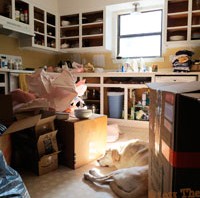
    This may well become one of my favorite pictures of Nikki lying in the sunlight. It was a pain stepping around her but you gotta love that she’s a constant companion.

    I decided since the cabinet frames were painted and I was hitting a brick wall on finding 1/4″ MDF at a lumber yard that would cut it into 3″ strips so I could update the cabinet doors that I should go ahead and unpack some boxes so I could cook more.

    Unpacking kitchen and painting prep - TheDIYGirl.comUnpacking the boxes would also make it easier for me to get to the walls to remove the remaining chair rail, repair the drywall, and paint the walls. You can see the chair rail running along the wall behind the microwave.

    Besides, it was a blessed relief to have a full set of dishes, silverware, food prep, and backing dishes. Amazing how much you miss the stuff when you don’t have it.

    After everything was put away it was time to get the chair rail off and repair the drywall where it had been. This was going to be especially important since I was using a satin paint that would show all the flaws in the drywall. I was planning on getting Clark + Kensington from Ace Hardware again.

    Repairs

    Unpacking kitchen and painting prep - TheDIYGirl.com
    Future home for light over sink, soffit scraped clean of popcorn, primed and ready for paint

    Unpacking kitchen and painting prep - TheDIYGirl.comI filled all the holes and spread a thin coat of mud to eliminate any sign of where the chair rail had been. I then sanded it with a drywall sanding screen, filled a few problem areas, allowed that to dry, and sanded again. The kitchen walls were easy (other than the sanding dust).

    I had an electrician out to add outlets along the backsplash, wire an outlet for a light over the sink and run a switch for it. I hung the new sink light.

    I’d removed the board that had hidden a cheap flourescent light over the sink that had a cord going to one of the backsplash outlets. Not only was this ugly, but violated code.

    Unpacking kitchen and painting prep - TheDIYGirl.com
    Popcorn on soffit and ugly board over sink

    I had already sprayed the soffits with water and then scraped off the popcorn texture so I could paint them the same color as the walls. Removing popcorn is a messy job. Who puts popcorn on soffits???

    The last thing I did was caulk along the baseboards all around the room. I taped off the cabinets and the baseboards after the caulk had dried and I was ready to paint.  Woohoo!

  • Shaker Kitchen Cabinet Update – painting tips

    Shaker Kitchen Cabinet Update – painting tips

    I won’t go into detail — after everything else I’ve written about painting kitchen cabinets it would be about interesting as, well, watching paint dry. So just some observations.

    Read the label

    Shaker Kitchen Cabinet Update - painting tipsAs mentioned I am using Benjamin Moore’s ADVANCE Waterborne Interior Alkyd Paint – Satin Finish (792). I got curious about Alkyd — their site says Water Reducible Alkyd.  Apparently the major components of an alkyd coating are fatty acids and triglyceride oils and are not petroleum products, but slow the drying time so you end up with a harder finish. On kitchen cabinets this is a good thing.

    If you try the paint be sure to read the label. It is water clean up, but because of the alkyd oil they recommend a final rinse in mineral spirits for your tools. This is how my tools looked yesterday after soaking in paint for the 3 hours it took me to do the second coat.

    Shaker Kitchen Cabinet Update - painting tips
    Cleaned and ready for next coat

    The other important difference is the drying time. They say a minimum of 16 hours before sanding and applying another coat. I let it dry longer since the house is only around 65 degrees.

    Technique

    I feel the second coat went better, but that was because it got down to a routine that I knew worked. The upper cabinets take the longest, partly because I’m painting the shelf fronts, partly because the bottoms of the upper cabinets need to be painted, and partly because there are more of them. The base cabinets probably only took 45 minutes, including painting the toe kick area.

    I did treat myself to a new short handled brush to make easier working inside the cabinets edges — I purchased a Purdy XL Cub. The stubby handle is great for working in small spaces.

    I suggest a very, very light touch with the roller to prevent runs. There are so many edges and corners when painting cabinets that any pressure could unknowingly leave a load of paint that will run after you have moved on to the next section.

    With great sadness I gave up on using a foam brush and went back to my old stand by — quality bristle brushes. I may have had to spend time cleaning, but the application was so superior I was glad I made the switch. The XL Cub did a such a nice job.

    Cleaning

    The mohair roller and brush clean up first with soap and warm water. I always use Dawn dish detergent because it contains grease and oil cutters. After getting as much moisture out as possible with a towel, I then dunked both in mineral spirits and squeezed that out. They look virtually unused after cleaning.

    If you use a painter’s tool with the crescent shape to get water out of the little rollers be very gentle. I was too rough after the primer and started loosening tufts and felt the smart thing was to discard that roller or the loose tufts would end up in the paint. I quit using the painter’s tool and used my hands only to remove water and it worked a lot better. The painter’s tool is a new thing for me and I’m not good with it yet.

    The plastic rolling tray, brush, and roller are all in perfectly good condition to be used again.

  • Replacing ceiling light with ceiling fan

    Replacing ceiling light with ceiling fan

    Over the years I have replaced quite a few ceiling lights with a ceiling fan/light. Since I tend to be frugal with my air conditioning dollars, fans are important for comfort in the hotter months.

    Ceiling lights don’t require a whole lot of support, unless they have to be a chandelier so support is the biggest issue when replacing a standard ceiling fixture with a fan. It’s not just the weight of the fan, but the vibration and movement when it’s running.

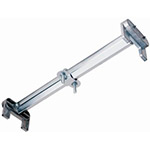
    I have had great luck using the Reiker 33000. It’s a really solid support that inserts through the standard opening for ceiling fixtures and then you turn it to extend it out to embed the feet into the rafters on either side of the hole. Once properly installed you can hang from the support, so it definitely will hold the weight of a fan.

    After it’s properly installed all you need to do is install an electrical box, pulled the wires through and start the fan installation. This is, of course, all done with the breaker switch in the off position from the time you start to remove the old light fixture and until you have completed the fan install. No getting knocked off the ladder by an electrical zap.

    My most recent conversion to a fan was the most problematic I’ve encountered. The flimsy support for the existing fixture was nailed in and required a trip into the attic to remove the old support. From that point forward the install could be completed from the room.

    Fan selection

    Replacing ceiling light with ceiling fan - TheDIYGirl.com
    Fan from Lowe’s

    Since I am most likely updating this house to sell I don’t want to invest in expensive fixtures so I decided to try the Harbor Breeze 52-in Armitage White Ceiling Fan with Light Kit from Lowe’s. It sells in my area for $38.88. It’s a cute fan when installed, but I have no idea how it will hold up with use. I will report on how it works after using it for a few months.

    The installation instructions were excellent and the fan installed easily. The wiring diagrams were very straight forward.

    I like how the light looks and so far the fan itself runs very quietly.

    Replacing ceiling light with ceiling fan - TheDIYGirl.com

    As long as you are comfortable with electrical wiring, this conversion is something any homeowner can do on their own.

    The DIY Network has a good how-to video: How to Brace a Ceiling Fan

    FYI — this is what the living originally looked like:

    Replacing ceiling light with ceiling fan - TheDIYGirl.com
    This light fixture was moved to the kitchen where it belonged in the first place. A hanging light in the middle of the living room?