
Tag: faucet repair

  • Dripping faucet is an easy fix

    Dripping faucet is an easy fix

    I have a Moen kitchen faucet that suddenly started dripping right after I put my house on the market to sell. Not exactly the look I wanted for showing – a spattered sink and dripping faucet.

    A failing faucet cartridge is almost always the reason for a dripping faucet and is usually not a difficult fix.

    Figuring out what cartridge you need

    In the past I have taken bathroom faucet cartridges to the hardware store and they have matched it up to the correct replacement. This time I couldn’t even get the handle off and needed directions on how to accomplish that. There was a hole on the back of the handle and using a mirror I could tell there was a set screw in the hold that most likely needed an allen wrench. I tried and tried and could get a wrench to seat and couldn’t get the handle off. While most faucets are really easy to disassemble, this particular faucet was not a friendly design for repairs.

    I searched the Moen site. Since I purchased this house as a foreclosure I had no idea what the model of the faucet was. I took pictures of the faucet and emailed them to Moen customer service and they emailed me back with the model number so I could order the replacement cartridge – this process took about 48 hours so be patient. (Note: if you are the original owner of the faucet, Moen guarantees their faucets for like and will probably send you a new cartridge for free.)

    Unfortunately this Moen cartridge wasn’t available locally so I had to order it from Moen at over $20. Yikes.

    Replacing the cartridge

    When the cartridge arrived I called customer service to ask how to remove the handle. It required a 3/32 allen wrench – you have to be kidding me. They don’t etch sizes into little allen wrenches and I didn’t have a fold out tool that had sizes that small. Since it faced away from me I asked specifically whether I needed to turn the wrench clockwise or counter-clockwise and was told counter-clockwise while facing the faucet. That seemed counter intuitive to the lefty loosey/righty tighty idea, but okay. I assumed they knew their faucets. Note the instruction below do NOT show a faucet with a set screw in the back.

    Dripping faucet is an easy fix - The DIY Girl
    Cartridge and instructions

    Before replacing a faucet cartridge TURN THE WATER OFF going to the faucet.

    Working blind I tried allen after allen and finally felt one seat into the screw. I turned the wrench to the left or counter-clockwise and the handle wouldn’t let go. I didn’t want to ruin the set screw, so back on the phone to Moen to confirm which way would loosen. I had been told incorrectly —  I needed to turn it to the right or clockwise to loosen the set screw.

    Dripping faucet is an easy fix - The DIY Girl
    Faucet with allen wrench finally in place
    Dripping faucet is an easy fix - The DIY Girl
    View from the top with allen wrench in place
    Dripping faucet is an easy fix - The DIY Girl
    Handle off, ring removed, and nut removed
    Dripping faucet is an easy fix - The DIY Girl
    It was easy to pull out the cartridge — not all cartridges remove this easily
    Dripping faucet is an easy fix - The DIY Girl
    New cartridge inserted

    After figuring out the set screw the repair was a breeze. The handle came off, a top cover ring slid off, a nut easily came off and I was able to pull the old cartridge out by hand. I popped in the new cartridge, put all the parts back together, turned the water on and no drip!

    Don’t ever let a faucet drip. Avoid the annoyance and the wasted water and do this easy fix as soon as it’s needed.
  • Repair leaking bathroom faucet handle

    Repair leaking bathroom faucet handle

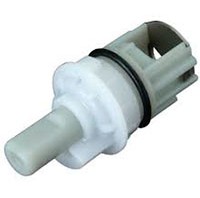
    I have Delta/Delex faucets with separate hot and cold water handles. The first time I had a leaky faucet I took out the old valve stem and went to a home improvement store and asked them to help me match it. I purchased a box of 5 valve stems, springs, and seats. I figured this wouldn’t be the only leak since I have 6 identical faucets in three bathrooms.

    Tool list

          • Phillips head screwdriver
          • channel locks
          • needle-nose pliers
          • small screw driver
          • rags

    I turned the water off under the sink going to both faucets. The turn valves don’t seem to age well and this always makes me a little nervous since they can break. I once had a valve to a toilet break and start pouring water into the bathroom until I shut the water main off. Which brings up a good point. Before starting a plumbing project make sure you know where the main shut off is and how to turn it off (some need a tool) just in case something goes wrong unexpectedly.

    To get to the valve stem I had to pop the caps that say “H” and “C” on the top of the faucet handles, remove the screw, and remove the plastic handle.

    The handle is screwed into the top of the valve stem. To get the valve stem out on the Delta/Delex there is a brass ring that needs to be removed. I wrapped it in a cloth (to prevent damage to the ring) and used a channel locks to turn counter-clockwise and remove the ring.

    If the ring has gotten stuck due to hard water deposits, I have had to soak a cloth in white vinegar and wrap it around the ring. I let it sit for a few minutes to allow the acid in the vinegar to work on the deposits. DO NOT get too aggressive if the ring is stuck since you could turn the entire thing and kink the copper tubing under the sink.

    Once the ring was off I still had a hard time getting the hot water valve stem out and had to work around the edge with a small screwdriver prying it and while being careful to not gouge up the brass.

    When the old valve stem was out I used rags to soak up the water down in the hole. At the bottom is a round black rubber seat. I removed it with a needle-nose plier. Once that was out I could see the spring under it and removed it also. I took care to note the direction of the seat and the spring when I removed them so I could make sure I put the new parts in correctly. The spring is narrower on one end and needs to go in the correct way.

    If I’m replacing a valve stem I go ahead and replace the seat and spring while I have it disassembled. I’m never sure what exactly is leaking and it seems wise to start with all fresh parts.

    I put the seat over the spring, grabbed the assembled seat/spring with a needle-nose and inserted them in the hole. I used the handle end of a small screwdriver to push the seat down into place.

    Once the seat and spring were in, it was a simple matter of putting in the new valve stem and screwing down the brass ring. I was careful to tighten the ring, but stop when the whole thing started to turn — again not wanting to kink the copper tubing under the sink.

    I screwed the handles back on, popped the “H” and “C” in making sure they were on the correct handle.

    I turned the water back on under the sink and tested both faucets. No leaks!