Tag: Benjamin Moore’s Fresh Start Primer

  • Shaker Kitchen Cabinet Update – Painting the doors and drawers

    Shaker Kitchen Cabinet Update – Painting the doors and drawers

    Finally. It took almost 2 weeks for me to get all the MDF strips done. I was working in the basement and the cool temperatures made the drying time for the Liquid Nails take forever.

    I had stumbled across the original post where the paint choice and instructions had come from at Ask the Paint Gurus http://paintgurus.typepad.com/blog/2011/01/the-right-way-to-re-finish-kitchen-cabinets.html. It’s a Benjamin Moore site. It’s a good write-up and I’d recommend a read for anyone planning to paint their cabinets.

    Shaker Kitchen Cabinet Update - Painting the doors and drawers - TheDIYGirl.com
    Using an old door as a work table along with my cutting table

    Set up

    I had saved a wooden door (I replaced a wood interior door that led to the garage with a steel door and dead bolt) for a large work surface and also used a cutting table I have for sewing. I have a room full of doors. The drawer fronts were in the bedroom to the side. I had to remove the drawer glides from the bottom so they would sit flat for painting.

    The backs were already sanded so I just needed to wipe them down before painting.

    I wanted to start with the backs to iron out any painting problems I might run into before doing the more visible fronts.

    Priming

    Shaker Kitchen Cabinet Update - Painting the doors and drawers - TheDIYGirl.com
    Primed on right and first coat of paint on left

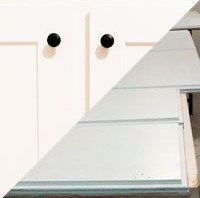
    I’m using the Fresh Start primer from Benjamin Moore and a wool roller to apply to primer. I primed the 3/8″ inset with a foam brush and rolled the backs applying only a very thin, but thorough coat of primer using the lightest touch possible with the roller.

    The point of primer here is to provide a good adhesion surface between the door and the new paint. The purpose isn’t to blot out any sign of the former color. 2 coats of primer to completely cover the previous color is a waste of time. One well applied coat is all that’s needed.

    When all was said and done I thought it looked a little blotchy from the roller tufts and was worried the blotches would translate to lumpy when it dried. It smoothed out fairly well when dry, but I threw out the roller. I didn’t want to risk a lumpy appearance with the paint.

    I sanded the primer with a 320 sanding block and wiped the sanding dust off with a rag dipped in mineral spirits. The doors felt smooth to the touch.

    Two coats of paint

    Shaker Kitchen Cabinet Update - Painting the doors and drawers - TheDIYGirl.com
    Doors with second coat of paint

    I switched to a different roller and still thought the paint looked a little lumpy after rolling, but this paint is incredible — it levels as it dries and by the time it had dried a few hours the alkyd paint looked really good.

    Since I was working on the backs of the doors I wanted to experiment a little before doing the fronts. After rereading http://paintgurus.typepad.com/blog/2011/01/the-right-way-to-re-finish-kitchen-cabinets.html I decided to try rolling and then doing a final full length brush strokes all the way across each door (what they call back brushing) . I had basically back rolled each door on the first coat after getting the initial coverage I did slightly overlapping strokes the full length of the doors.

    So far I think the back rolling with the roller gave better results than the back brushing after rolling. The doors have only been drying for 5 hours, so I’ll see how they look in the morning.

    Drying time

    Drying time is an issue with Benjamin Moore’s Advance paint. Since it’s an alkyd paint the standard drying time is 16 hours. Add cool temperatures and humidity and that drying time will be longer. 

    I let the doors dry for 2 days before flipping them over to do the fronts. I wanted the paint to be really dry so it wouldn’t stick to the wood blocks I set them on. I do not want paint to pull off when I lift the doors off the blocks.

    I the doors and drawers dry for a week before hanging/replacing them since I’m working on them in a cool basement, I want to make very sure they are thoroughly dry before handling them.
     

  • Shaker Kitchen Cabinet Update – painting prep

    Shaker Kitchen Cabinet Update – painting prep

    Shaker Kitchen Cabinet Update - painting prep - TheDIYGirl.com
    Deciding how much to paint

    I believe the first thing you need to do when contemplating painting cabinets is to take a real long look and decide how much. Just the face of the cabinet frames and the outside of the doors? Paint everything including the insides.

    Personally, even if you held a really big gun (and I mean something like a bazooka) you could not make me paint the inside of cabinets and fortunately I have cabinets with decent interiors.

    How much do you want to paint?

    So how much did I want to paint. The current green is only on the outside of the doors and I had already decided I wanted to paint both sides of the doors. Next the cabinet frames. I want them to really feel like white cabinets when I  open the doors (hence painting the inside of the doors) so I scrutinized where I wanted to draw the line on white. I wanted to let difficulty dictate it — not going to go there if it was too hard to do.

    The shelves on the base cabinets were recessed so I wasn’t worried about them. The design of the base cabinets made it easy to paint the inside of the door opening. I felt the upper cabinets needed the same treatment — paint the inside of the door opening. Paint the front of the shelves? The are covered with trims that cups the front edge of the shelves so I decided to paint the top, front, and bottom of this trim.

    You have to make these decisions first so you know what to prep. The more you paint the more you prep — unless you’re painting everything.

    I covered the table and all the boxes of my packed kitchen with plastic and taped plastic over the doorway to to living room to try to contain the sanding dust.

    Shaker Kitchen Cabinet Update - painting prep - TheDIYGirl.com
    Hardware removed and everything washed

    It’s important that all grease, oils, and dirt be removed so that nothing interferes with the paint adhering, so after I had removed the doors and drawers and taken off all the hardware I used a strong solution of Dawn dish washing soap (known for it’s grease cutting) and a scrubbie pad and scrubbed the living daylights out of every surface I was going to paint.

    After washing I went back and thoroughly rinsed everything to make sure there was no soap residue left on the surfaces. Again — maybe this was overkill since I was going to be sanding, but after seeing the sides of the stove I chose to err on the side of caution. Nothing would be worse than painting all the cabinets and several months down the road have the paint start peeling.

    Shaker Kitchen Cabinet Update - painting prep - TheDIYGirl.com
    cabinets sanded

    I used my palm sander with 60 grit sandpaper and went over all the surfaces I planned to paint. I followed up with 220 grit paper to smooth the surface.

    It may have been overkill but after cleaning up all the sanding dust, I followed this with wiping all the surfaces with deglosser. I know there are VOC versions of this stuff and I would recommend getting it. I had the non-VOC version and the fumes were horrible. The rag I used went outside as soon as I finished.

    Last thing to do was to tape off the bottom shelved of the wall cabinets to delineate the inside of the opening from the floor of the cabinet.

    Shaker Kitchen Cabinet Update - painting prep - TheDIYGirl.com
    taped edge

    FYI – I dreaded pulling out the stove. I wasn’t sure how it would slide over the floor and expected the floor underneath it to be gross. The floor wasn’t gross. The sides of the stove were disgusting. Lots and lots of cooking grease has run down the sides and never been cleaned. Note to self — if you live somewhere with a stove, pull the things out once a year and clean the sides. I’ve lived with a built-in oven and cooktop previous to this, so never had to deal with it.

    Shaker Kitchen Cabinet Update - painting prep - TheDIYGirl.com
    Note the grease running down the sides

    Ready for Primer

    After a lot of sanding, washing, and deglossing I felt the cabinet frames were ready for primer. Painting cabinets is such a big job I wanted to make sure the paint stuck really well.I didn’t mention, but I also sanded and deglossed the black toe kick board under the cabinets so I could get it painted white to match the cabinets.

    Putting on the primer

    Painting the frames is covering a lot of narrow areas. I opted to use a wool small roller to get the smoothest finish possible. You have to use a really light touch with the roller to avoid runs. I used a brush to get the corner of the openings, along the wall, and the sides of the shelf trim close to the door openings. Then I rolled the inside of the door openings and the shelf trim top, bottom, and front, and finally the front of the wall cabinets. Since I had pulled the stove out it was easy to reach the inside of the cabinets facing the stove.

    Shaker Kitchen Cabinet Update - painting prep - TheDIYGirl.com
    Cabinets with primer coat

    The last thing I did on the wall cabinets was paint the bottoms. They consisted of a lot of cutting in with a brush and then rolling the bottom wood.

    I moved on to the base cabinets, using a brush again to do the inside corners of the openings, rolled the inside of the door openings, rolled the fronts and then the toe kick area. Yikes. Painting cabinets is tedious, tedious, tedious…

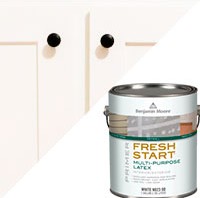
    A note about primer. Some people think you have to completely blot out the surface below the primer. The primer I was using was meant to be a binding layer between the old paint and the new paint — not completely cover the old paint. I confirmed this with the folks at Benjamin Moore. So while I did make sure I had an even layer of primer on all surfaces, you could still see the green through it. Benjamin Moore told me a second coat of primer is not necessary.

    The worst part of painting cabinets

    Without question the worst part of the process is the under side of the wall cabinets. I ended up clearing off the counters and laying on my back so I could see what I was doing and it was still a pain. There is so much that has to be painted with a brush because of the insets. I don’t feel like it looks all that great, but I don’t figure too many people are going to perusing the bottom of my cabinets so as long as they’re white, I’m not going to worry about it.

    Shaker Kitchen Cabinet Update - painting prep - TheDIYGirl.comShaker Kitchen Cabinet Update - painting prep - TheDIYGirl.com


    Note the additional electrical outlets on the backsplash on either side of the sink and the old-fashioned board is gone over the sink 🙂

    Need I mention how hard it is to use a kitchen while you’re doing this kind of project. If it wasn’t for the stove surface, I’m not sure what I would have done…

    This shows how much I painted on the frames

    Shaker Kitchen Cabinet Update - painting prep - TheDIYGirl.com