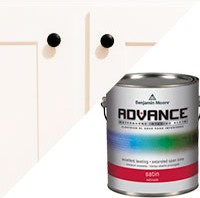
Tag: Benjamin Moore’s Advance Waterborne Interior Alkyd Paint

  • Shaker Kitchen Cabinet Update – Painting the doors and drawers

    Shaker Kitchen Cabinet Update – Painting the doors and drawers

    Finally. It took almost 2 weeks for me to get all the MDF strips done. I was working in the basement and the cool temperatures made the drying time for the Liquid Nails take forever.

    I had stumbled across the original post where the paint choice and instructions had come from at Ask the Paint Gurus http://paintgurus.typepad.com/blog/2011/01/the-right-way-to-re-finish-kitchen-cabinets.html. It’s a Benjamin Moore site. It’s a good write-up and I’d recommend a read for anyone planning to paint their cabinets.

    Shaker Kitchen Cabinet Update - Painting the doors and drawers - TheDIYGirl.com
    Using an old door as a work table along with my cutting table

    Set up

    I had saved a wooden door (I replaced a wood interior door that led to the garage with a steel door and dead bolt) for a large work surface and also used a cutting table I have for sewing. I have a room full of doors. The drawer fronts were in the bedroom to the side. I had to remove the drawer glides from the bottom so they would sit flat for painting.

    The backs were already sanded so I just needed to wipe them down before painting.

    I wanted to start with the backs to iron out any painting problems I might run into before doing the more visible fronts.

    Priming

    Shaker Kitchen Cabinet Update - Painting the doors and drawers - TheDIYGirl.com
    Primed on right and first coat of paint on left

    I’m using the Fresh Start primer from Benjamin Moore and a wool roller to apply to primer. I primed the 3/8″ inset with a foam brush and rolled the backs applying only a very thin, but thorough coat of primer using the lightest touch possible with the roller.

    The point of primer here is to provide a good adhesion surface between the door and the new paint. The purpose isn’t to blot out any sign of the former color. 2 coats of primer to completely cover the previous color is a waste of time. One well applied coat is all that’s needed.

    When all was said and done I thought it looked a little blotchy from the roller tufts and was worried the blotches would translate to lumpy when it dried. It smoothed out fairly well when dry, but I threw out the roller. I didn’t want to risk a lumpy appearance with the paint.

    I sanded the primer with a 320 sanding block and wiped the sanding dust off with a rag dipped in mineral spirits. The doors felt smooth to the touch.

    Two coats of paint

    Shaker Kitchen Cabinet Update - Painting the doors and drawers - TheDIYGirl.com
    Doors with second coat of paint

    I switched to a different roller and still thought the paint looked a little lumpy after rolling, but this paint is incredible — it levels as it dries and by the time it had dried a few hours the alkyd paint looked really good.

    Since I was working on the backs of the doors I wanted to experiment a little before doing the fronts. After rereading http://paintgurus.typepad.com/blog/2011/01/the-right-way-to-re-finish-kitchen-cabinets.html I decided to try rolling and then doing a final full length brush strokes all the way across each door (what they call back brushing) . I had basically back rolled each door on the first coat after getting the initial coverage I did slightly overlapping strokes the full length of the doors.

    So far I think the back rolling with the roller gave better results than the back brushing after rolling. The doors have only been drying for 5 hours, so I’ll see how they look in the morning.

    Drying time

    Drying time is an issue with Benjamin Moore’s Advance paint. Since it’s an alkyd paint the standard drying time is 16 hours. Add cool temperatures and humidity and that drying time will be longer. 

    I let the doors dry for 2 days before flipping them over to do the fronts. I wanted the paint to be really dry so it wouldn’t stick to the wood blocks I set them on. I do not want paint to pull off when I lift the doors off the blocks.

    I the doors and drawers dry for a week before hanging/replacing them since I’m working on them in a cool basement, I want to make very sure they are thoroughly dry before handling them.
     

  • Shaker Kitchen Cabinet Update – painting tips

    Shaker Kitchen Cabinet Update – painting tips

    I won’t go into detail — after everything else I’ve written about painting kitchen cabinets it would be about interesting as, well, watching paint dry. So just some observations.

    Read the label

    Shaker Kitchen Cabinet Update - painting tipsAs mentioned I am using Benjamin Moore’s ADVANCE Waterborne Interior Alkyd Paint – Satin Finish (792). I got curious about Alkyd — their site says Water Reducible Alkyd.  Apparently the major components of an alkyd coating are fatty acids and triglyceride oils and are not petroleum products, but slow the drying time so you end up with a harder finish. On kitchen cabinets this is a good thing.

    If you try the paint be sure to read the label. It is water clean up, but because of the alkyd oil they recommend a final rinse in mineral spirits for your tools. This is how my tools looked yesterday after soaking in paint for the 3 hours it took me to do the second coat.

    Shaker Kitchen Cabinet Update - painting tips
    Cleaned and ready for next coat

    The other important difference is the drying time. They say a minimum of 16 hours before sanding and applying another coat. I let it dry longer since the house is only around 65 degrees.

    Technique

    I feel the second coat went better, but that was because it got down to a routine that I knew worked. The upper cabinets take the longest, partly because I’m painting the shelf fronts, partly because the bottoms of the upper cabinets need to be painted, and partly because there are more of them. The base cabinets probably only took 45 minutes, including painting the toe kick area.

    I did treat myself to a new short handled brush to make easier working inside the cabinets edges — I purchased a Purdy XL Cub. The stubby handle is great for working in small spaces.

    I suggest a very, very light touch with the roller to prevent runs. There are so many edges and corners when painting cabinets that any pressure could unknowingly leave a load of paint that will run after you have moved on to the next section.

    With great sadness I gave up on using a foam brush and went back to my old stand by — quality bristle brushes. I may have had to spend time cleaning, but the application was so superior I was glad I made the switch. The XL Cub did a such a nice job.

    Cleaning

    The mohair roller and brush clean up first with soap and warm water. I always use Dawn dish detergent because it contains grease and oil cutters. After getting as much moisture out as possible with a towel, I then dunked both in mineral spirits and squeezed that out. They look virtually unused after cleaning.

    If you use a painter’s tool with the crescent shape to get water out of the little rollers be very gentle. I was too rough after the primer and started loosening tufts and felt the smart thing was to discard that roller or the loose tufts would end up in the paint. I quit using the painter’s tool and used my hands only to remove water and it worked a lot better. The painter’s tool is a new thing for me and I’m not good with it yet.

    The plastic rolling tray, brush, and roller are all in perfectly good condition to be used again.

  • Shaker Kitchen Cabinet Update – painting boxes

    Shaker Kitchen Cabinet Update – painting boxes

    I have been very frustrated that other blogs have introduced the idea of a Shaker kitchen cabinet update and then provided next to NO details on how to do it. No mention of what wood, what thickness, what width strips, how they cut it, what type of adhesive they used. Nothing. Very frustrating.

    So for better or worse, I’m going to provide excrutiating detail of what I do with this Shaker kitchen cabinet update. I will tell you what I do and whether it works or not.

    The paint

    Since I want the paint to bind really well to the cabinets my plan is to err way on the side of caution with drying time.

    Shaker Kitchen Cabinet Update - painting boxes - TheDIYGirl.comI put the primer on yesterday, so I allowed the cabinets to dry overnight before painting.

    After reading the post at Young House Love on cabinet painting I purchased Benjamin Moore’s Fresh Start Primer and Benjamin Moore’s Advance Waterborne Interior Alkyd Paint – Satin Finish. The primer went on yesterday and I applied the first coat of paint today. For both primer and paint I’m working with a mohair blend roller for the smoothest finish possible.

    Shaker Kitchen Cabinet Update - painting boxes - TheDIYGirl.comI followed the same routine I used for the primer written up in a previous post. The primer had allowed a lot of the green paint on the cabinets to show through, but this first coat of paint finally covered it up. I was not sorry to say goodbye to the green paint.

    I am hoping I can get by with 2 coats of paint over the primer, but will do a 3rd coat if it’s needed to cover well. I will allow a lot of drying time between coats (more than specified on the can) to make sure I get good adhesion.

    First coat

    Here’s how the cabinets are looking after a coat of primer and one coat of paint. The can says 16 hours drying time — I gave it 24 hours.

    Shaker Kitchen Cabinet Update - painting boxes - TheDIYGirl.com
    First coat of paint

    Second Coat

    I took a day off to let my hands recover. Between the split skin on my thumbs from all the drywall work and the oops cut I added today when carving the polystyrene I think my hands need a day off to recover. It would give the paint more time to dry.

    Shaker Kitchen Cabinet Update - painting boxes - TheDIYGirl.com
    Second coat of paint


    The second coat looks great. Note how nice the trim I added at the top of the cabinets looks with a coat of paint on it 🙂 It all looked good enough that I pushed the stove and refrigerator back even though I feel I need to put another coat on the bottoms of the upper cabinets. I’ve been laying on the counters to do that so the appliances won’t make a difference.

    So far I’m happy with what I chose to paint. I think painting the front edges of the shelves in the upper cabinets is going to give them a great appearance when the doors are open.

    I do think I will roll a third coat of paint on the fronts of all the cabinets because I’m applying such thin coats.

    Now if I can find someone to help me cut the wood I need to make-over the door and drawer fronts. So far I’m not having any luck. I’ve started wondering if I should just them white as is and see how that looks.