I’ve been wanting to change my bedroom for months and have gone through so many iterations of headboard designs that it was getting ridiculous. I wanted it to be coastal. I wanted to be able to build it alone and get the materials home in my Xterra and most importantly I didn’t want it to cost all that much. I really should have name my site the FRUGAL DIY Girl…
Plan
Once I had arrived at the plan for the bedside tables I could move forward with the headboard. The open style of the tables meant I could have a large, solid headboard and it wouldn’t be too overpowering.
I decided on using primarily 2 x 6 for strength and low cost instead of 1 x 6. I purchased verified a pack of 8 ft. x 4 in. x 5/16 in. Knotty Pine Edge V-Plank Kit (6-Piece) from HD cut into 24″ pieces would be more than enough to be the back panel. I have 1 8′ piece left over. Some trim and a 1 x 6 for the top shelf was all I would need besides paint.
8 ft. x 4 in. x 5/16 in. Knotty Pine Edge V-Plank Kit (6-Piece Pack) from Home Depot
Layout
I checked and double checked the height of my mattress and boxspring to make sure the leg height would be right. I wanted to wall showing (obviously) but most of that bottom board showing.
Assembly
I had to get creative during the assembly process. I continued using my Harbor Freight pocket hole jig I purchased and I’m finally getting somewhat decent at pocket holes. I refused to pay the ridiculous price for a plastic Kreg jig and I needed one that clamped the wood and held the board while drilling.
Since I don’t have any clamps large enough for a headboard I used ratcheting tie down straps to hold everything tight while I assembled the frame.
When the frame was assembled I put the headboard face down on the floor and glued and nailed the planks starting in the middle and working out to each side.
After the center section was on I added trim molding across the top and the 1 x 6 board to the top. Filled holes, caulked gaps, and painted Benjamin Moore Barnwood in high gloss enamel which is a grayish brown, brownish gray. I love the color.
I will not put anything on paint or finish until it’s dried for 30 days. Too much work to build and paint something and then get impatient and ruin the finish by putting decor items on too early. I have to figure out what color fabric to wrap the box spring in (see Bed legs alternative to bed frame) and what I want to do for lamps on the DIY Industrial adjustable bedside tables, but I will want some coastal items on the top shelf on the headboard and possibly a clamp on reading lamp. I’ll worry about that when the paint has cured.
I’ve done a lot of searching for ideas for a new headboard and side tables and ran across this image on Better Homes and Gardens:
Let me count the ways: I loved the pedestal open bedside tables instead of something closed and solid. I loved that the headboard was rustic and wider than the bed so it served as a frame. I really loved the lights mounted on the headboard but that’s a whole other issue to be tackled later.
The table base
I did a little looking around the internet and found these at Beekman 1802:
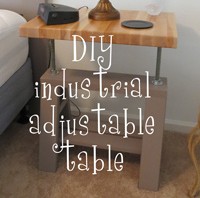
Oh my. They even show is being used as a bedside table. Unfortunately the price for each table is $600. Only $1200 for two. Since I didn’t have access to or budget for the metal table bases I started searching for a way I could make an industrial adjustable bedside table base and found it on Ana White.
I thought about making the adjustable bar stool for the table base, but opted for the additional stability the table top would have with two supports.
The table top
I have two 36” x 24” Butcher block tops left over from the UPS massacre after I ordered from grizzly.com when making the kitchen island for my previous house.
UPS dropped the first two tops crunching corners so grizzly got pictures of the damage from me and kept sending replacements. The 3rd try they double boxed and doubled the corner protection. This box was also dropped hard enough to crunch the corners of the box, but the butcher block was undamaged. Finally. All to say I was left with 2 tops that had damaged corners. Not horrible damage, but bad enough I didn’t want them for the island in a house I was trying to sell.
By the way – I would have liked to bring the island with me but the people who bought the house loved it so much they insisted the island be part of the deal.
Constructing the bases
This is the first time for me to work with angle cuts and Ana White offered no clue about how to clamp the parts for assembly. Maybe other folks are smarter and more experienced at woodworking than I am… So I came up with a block that I used for clamping the legs. I clamped the block to the 2 x 6 table top and the leg to the block and then check to make sure they were square.
The rest of directions can be found on the link to Ana White above. The base is made of 2 x 4’s with a 2 x 6 top and 1 x 4 used for the shelf.
One suggestion – sand the pieces before assembly because they are a bugger to get to once assembled. Both sanding and painting were a pain. I think the next time I would even paint the pieces and then touch them up after assembly.
After they were painted all that remained was the hardware and tops.
Adjustable hardware
I thought the information on Ana White for the hardware required for these adjustable tables was sketchy at best and really not sufficient to know what to do. I went to the store and tested ½” flanges with ¾” threaded rod and the rod threaded in just fine. Lowes and HD both wanted over $10 per flange. Seriously??? $10 dollars for a flange. $40 for this project alone? I checked online and I could get 10 flanges for $29 off Ebay so I ended up with 10 flanges. I think I’ll add a pipe towel bar to my kitchen cart and possibly a pipe curtain rod for my sliding glass door to use the extra flanges. Or if someone needs flanges they can email be 🙂
After the flange size and threaded rod size were solved I needed to find the other parts. HD sells a pack of 4 ¾ inch washers, lock washers, and nuts for under $5. Lowes wanted $1+ for each washer and nut so I went with the pack. Ana White said you needed 8 nuts, but if you can find where the 4 extra nuts were used in the pictures you have better eyes than I do. The second set of nuts does show on the bar stool pictures.
I measured the tables and determined 18″ rods would be perfect. I bought 2 36″ sections of 3/4″ threaded rod and cut them in half with a hack saw. That was more fun than a barrel of monkeys but they don’t sell 18″ sections of rod. I read online that nuts wouldn’t go on over the cuts but that proved to be untrue. I threaded the good ends into the flange and was still able the add nuts to the bottom cut ends of all four pieces.
The table top had a little wobble so I had decided to lock them down tight by adding the nuts at the bottom of the threaded rod and snugging it up against the bottom support before I saw the second nut on the Ana White bar stool picture. I even used all the lock washers here so nothing went to waste from the HD package of nuts and washers. That always makes me happy.
Table tops
A friend cut the butcher block for me on a table saw so I had 2 roughly 18″ x 24″ tops. I put the raw cut edge facing the wall on both tables. I carefully measured and attached the flanges to the bottom of each top, screwed in the threaded rod and inserted into the bases. As I said above the tops moved a little so I added nuts and lock washers to the bottom and that firmed everything up.
The openness of the tables is just what I wanted. No matter what I do with mattresses I will be able to change the table top height of the Industrial adjustable bedside tables. The table top size is perfect. Now all I have to do is figure out what I want to do as far as lamps…
After spending months researching alternatives to a bed frame I stumbled across universal Bede’s at us-mattress.com. With all my research, how had I never seen them before? Here’s their description:
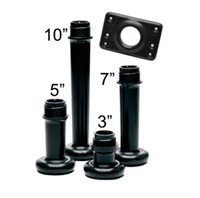
Are you tired of metal bed frames limiting the space underneath your bed? I don’t blame you! Here’s a tip – get rid of that metal frame and experience the new generation of mattress support! These bed legs are made from 100% recycled plastic and are available in four different heights so you can customize the amount of storage space under your bed.
The Universal Bedlegs System easily attaches to the box spring utilizing two components: the threaded base plate and the bed leg. The threaded base plate installs directly onto the box spring and the leg simply screws into the threaded area of the base plate to complete the installation. Once the base plate is secured to the box spring using a power screwdriver, you can easily resize the height of your bed without any tools by simply attaching a different size leg. Please note that this system only works with box springs that have a wooden center support and 2.25″ wood sides. This product is not compatible with box springs that have metal center supports.
• Made from 100% recycled plastic
• Available in four heights: 3″, 5″, 7′ and 10″
• Optional headboard brackets will accommodate most headboards
Includes:
Twin: 6 Threaded Leg Stems, 6 Base Plates, 24 Philips head screws
Full: 9 Threaded Leg Stems, 9 Base Plates, 36 Philips head screws
Queen: 9 Threaded Leg Stems, 9 Base Plates, 36 Philips head screws
King: 12 Threaded Leg Stems, 12 Base Plates, 48 Philips head screws
They are also available on Amazon in more colors and at $60. I wanted black so I went with the cheaper price. The 7” queen set was $55 and free shipping so I ordered them.
I had seen other furniture legs online, but they were at least $8-10 each and needing 8-9 of them I didn’t really want to spend $100 just for legs. $55 seemed pretty reasonable for what I thought were metal legs.
What I failed to note and was shocked to discover when the package arrived is the product is made of plastic. Didn’t read very closely, did I? The pictures looked metal, I thought metal, and didn’t see plastic. I mean – who would support a bed on plastic brackets and legs?? Apparently I would since I didn’t know what else to do. I didn’t want a heavy wood frame, I didn’t want to eliminate the box spring with a platform in humid Florida (I think the mattress needs to breathe), and I was sick to death of bed frames and bed skirts and was ready for a totally different look.
Installation and reinforcement
I leaned the mattress and box spring against the wall and disassembled the bed frame that was heading to the spare bedroom. Less than a year old and the fiber cover was already loose a quarter of the way around the box spring. I put the box spring on the floor bottom side up and since the fiber cover was already so loose I removed it from 3 sides.
I examined the structure and was appalled. Knotty 1 x 3’s – knots are always weak spots. I thought paying almost $1000 for a mattress and box spring would get me something fairly decent. Considering I had to do a warranty claim on the original mattress because it broke down so badly and these were new replacement pieces less than a year old and clearly not of good quality, I guess you have to pay a lot more. Lesson for next time.
I ran to HD and bought 1 x 4’s to add some strength to the frame since I was taking the metal support away. I glued and screwed the boards in. I hoped this would add a little strength to the frame. I stapled the fiber covering back in place, ran a row of binding tape down the center and stapled that so the fiber wouldn’t sag in the middle.
Before installing the leg brackets I figured out the best placement and cut away padding so they would fit flat against the frame. Each bracket installs with 4 screws. When they were installed I added adhesive back Velcro hook around the entire bottom edge of the box spring and stapled it down. I planned to have Velcro loop on the edge of whatever bedskirts I make so they can be easily changed. I didn’t want to permanently “upholster” it and be stuck with the same color all the time – this way I will be able to change it out.
Flipping it over
The installation instructions tell you to have 2 people to flip the mattress over so you don’t snap off the legs on one side. I got around this by putting the box spring up on 8” boxes. When I went to lay the mattress on the floor one edge was caught on the boxes so it was 1” off the floor. Then it was just a simple matter of lifting the edge of the box spring to remove the boxes. No broken legs (mine or the bed) and only one person to flip it.
The jury is out
I have no idea if these legs are going to work long-term, but I’m going to give them a try. I have considerable concern about my crappy box spring with no metal support for it, which is no fault of the legs. I don’t know if I’ll slide the bed and a leg will end up breaking off since they’re plastic, although the bed does slide fairly easily across the carpet. I don’t know if I’ll stub my toes on the legs and end up hating where they’re place.
So far there are no suspicious noises from the bed frame – no creaking or cracking sounds, thank heaven, but I sure won’t put it to the test by jumping up and down on the bed. Hopefully 9 legs under the bed will adequately support the spring, mattress, and me.
I do know I love the look with NO BED SKIRT. The legs don’t look obviously plastic. I like the black with the barnwood headboard. I want a plain white coverlet and pillow shams and then a bunch of coastal pillows on the bed. I’m still totally undecided about the color for the fabric cover for the box spring, but I’ll figure it out. I may have to get everything else in place before the right color become apparent to me.
I may make 6” rolling drawers and paint them the same color as the headboard for storage under the bed.
I will post a follow-up in a few months about how the legs and frame are holding up.
I have planned on making a living room table following the same design as bench I made for the entry. You can see the details on the bench here.
I think it’s only fair to point out the reason I make “rustic” pieces — it’s because I don’t have the tools or the know-how to produce a finely crafted piece of furniture. Rustic fits me and my style better anyway.
In designing it I had to start with the top and then back into the measurements for everything else. I wanted the top to be between 32-34” square. I decided on 2 x 6’s for the top since six 5.5” boards would total 33”. No other dimension lumber seemed to work out right.
Once I had the top size and determined the desired overhang of the top on the base I could start designing the base. Based on the couch and chair the table would be sitting next to I decided on 22” legs so the top of the table would be 23 ½” high. There’s a wide range of acceptable heights for living room tables so I picked what seemed like the perfect height for my furniture.
By the way – 2 untreated 8 foot 4 x 4’s were enough for the bench legs in the entry and these table legs with a small piece left over.
Assembly
Same basic assembly as the bench. I am not gutsy enough to cut all pieces in advance. I prefer to cut things as I go so I can measure and make sure the exact size of the piece I need.
I made a mistake with the supports and didn’t realize it until it was too late – the glue had already set up and I wasn’t going to rip it apart. I added an additional board so I would have an additional board to connect the top to. See the boo boo? The 2 boards that are flush with the bottom of the apron were supposed to be flush with the top so I added on top running perpendicular to them. Oh well — worse things could have happened. I’m still finding woodworking to be an adventure fraught with lots of mistakes.
After cutting the 2 x 6 boards for the top I glued and screwed them together using pocket hole screws. I’m still working on getting comfortable with my Harbor Freight pocket hole jig and so far I am so glad I did NOT spend the money to get a Kreg. The HF jig is definitely one of their products and is far from a piece of junk — which I believe is reflected in the fact they never really put it on sale, just a couple of dollars off.
Applying finish
I decided to leave the top and the base separate for finishing and would attach the top after 30 days of drying time. I used water based poly on the bench and decided on oil base for the table since glasses might drip on it and I wanted the most durable finish possible.
I really wanted the top to be nearly perfect so I did some experimenting with methods of applying the poly. You can read about that here. I am really happy with how the satin poly turned out. It’s so nice I will be proud to have the table in my living room.
Finished table
That’s all I have until the end of the 30 day drying period. I will attach the top to the base and get placed in the living and add more pictures of the finished DIY rustic living room table then. See you in 30!
In the meantime I’ll be trying to figure out what I want to do as far as a lamp for the new table.
I wanted to post pictures of some of the pvc dog cots that have been made. If you have used the tutorial to make a dog cot I would love to post pictures of your project and pets as well so send me an email. I’ll add more images as I receive them.
Kristin in Ontario
Kristin ordered a couple slings for her dogs Keely (fox red Labrador mix) and Ranger (brindle boxer-Wheaton terrier mix). The captions are Kristin’s from Instagram. I had to resist the urge to download 50 pictures because they were all so cute.
[nggallery id=12] Lisa in Colorado made a pvc dog cot (I sewed the slings for her) for Jenell. She couldn’t find the corner fittings in 1 1/2″ so she went with 1″ PVC and she said its supporting Jenell just find. I found out Jenell is part of a large family – 4 dogs, 5 cats, and 2 guinea pigs, most of which are rescue animals. As you can see, Jenell isn’t the only pet to like the PVC dog cot.
[nggallery id=10]
Crystal is the owner of P-King Kennels in Sarnia, Ontario and contacted me about making the dog cots to be used in the kennel She has had a little chewing of the fabrics slings, but overall is happy with the cots. Here’s some pictures of her cots and guests at the kennel.
[nggallery id=9]
Debbie and her husband are making a cot for their dog Lily.
Donna made two small cots for her dogs Pepe, Tawny, and Tia.
[nggallery id=7]
Tarah is making a variety of sizes as a fundraiser – here’s her first dog cot.
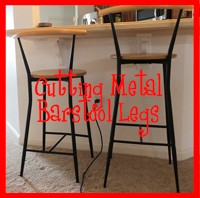
I moved from a house with a bar height bar to a counter height bar. I have great sentimental attachment to the bar stools I have to the point I don’t really care if the “go” with the house and decor, I can’t part with them — too many memories when I look at them. Maybe you found a great deal on bar stools with metal legs at a thrift shop but they are too tall for where you want to use them. There is a remedy.
Research
I found a good starting place with an ehow article How to Cut Metal Bar Stool Legs so I knew it was possible. I should have taken the advice offered in the article…
Look for 24″ high stools for a 36″ counter and 30″ high bar stools for 42″ high counters.
Then I needed to know how much room should be between seat and bottom of counter for user comfort and found this at HowtoDecorate.com:
Keep in mind you need 9″-13″ between the seat and the counter for seating comfort.
Now I knew how much I wanted to cut off, but didn’t relish the idea of using a hacksaw on 8 legs.
Methods tried
Keep in mind I had a little room for scratches since I planned on replacing the rubber legs tips when I was done cutting and they would cover any scratches right at the bottom of the legs.
The easy tools – tubing cutter and multi-tool. Both were failures.
I decided to try a power tool first in hopes it would quickly whisk the 8 legs off. I taped and marked the legs to prevent damage and found the multi-tool bounced all over the place before actually biting in and starting to cut. This could be the result of my lack of experience and a more experienced user might have much better luck. With great disappointment I decided that was not the way to go.
Next was the copper tubing tool I had from plumbing projects. It worked great on consistent diameter tube. It does not, however, work great on tapered tubing like the legs. I spiraled down the taper and there was no way I would get an accurate cut. I again set a tool aside with great disappoint.
What actually worked
The dreaded hack saw. I went to work with the hack saw, and while not fun, I cut all the legs off and corrected the bad cut from trying the copper tubing tool and both stools were mostly level when placed on a hard surface. I had one leg that was just a little short.
Leg tips
I had hoped to reuse the leg tips. Unfortunately, once cut the leg diameter went from 1/2″ to 5/8″. I wondered how much trouble I would have to go to to find 5/8″ black rubber legs tips. On online search showed HD and the hardware store were a waste of time. I have found that L may have things on their website and not in there stores. I almost jumped and down with joy when I walked in and found 4 packs of 5/8″ rubber tips in black.
Now for getting the buggers on.
Attaching the leg tips
Okay, so maybe the tubes were a tad over 5/8″ and the legs got wider where the tops of the tips would sit.
I had figured I could correct the the short leg by adding washers to the bottom of that leg tip. Then I decided washers would also prevent the ends of the legs from working their way through the legs tips over time so I bought a pack that fit perfectly into the leg tips. I used the handle of a wooden spoon to force the washers down into place.
It pretty much took brute force to start the leg tips and a hammer to get them all the way on. Good thing there were washers in there to prevent me hammering right through the bottom of the tips. All 8 tips on are. Man, I hope I never want them off. I would probably have to cut them off. On the bright side — I don’t ever have to worry about them falling off and the stools are nice and level.
So pleased
I don’t know if I may at some point paint the metal or the wood, but I do know when I put those stools in place and stepped back to look at them I just smiled. Silly how attached you get to things, but I am so glad I found a way to make them work with the shorter counter height and people will actually be able to sit on them 🙂
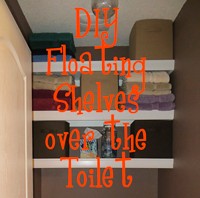
I have a house with no linen closet, but it does have a room for the toilet. I removed the towel bar that was over the toilet because I couldn’t see what good towels would do there since it was so far from the sinks and shower and badly wanted shelves or a cabinet for linen storage. Here’s the before picture.
Yawn…. is that not the most boring room you’ve ever seen.
The problem, that doesn’t show in the before picture, is the exhaust fan that’s not that far from the back wall that I felt eliminated the possibility of a closed cabinet — so that left DIY floating shelves over the toilet.
I had already painted the bathroom and removed the useless towel bar shown in the picture.
Lumber
The next stumbling block came when I wanted 3 42” wide by 16” deep shelves and hated to buy an entire sheet of plywood and have to store the remainder.
When I am in the lumber area of Home Depot I always cruise by to check the discounted lumber bin. It almost always horribly warped stuff that I couldn’t see any use for at all. Last week I checked and it had a sheet of birch plywood that had been split unevenly lengthwise. I asked the guys what was wrong with it and they said someone made an error and didn’t make the cut half way so they were discounting the pieces. $15. OMG. For a sheet of beautiful birch plywood.
I raced home and got the measurements of what I needed and raced back. They cut the three shelves and 2 2” strips that I could fasten to the wall and not have to buy 1” x 2”.
$15! I was excited.
Okay – so I splurged and bought vinyl 2 ¾” trim for the front edge that was $6.96. for each 8’ piece. All I would have to do is cut it, nail it, and fill the nail heads and I’d be done. Woohoo.
Planning
From this point forward I will always, ALWAYS measure, plan, and write down measurements BEFORE purchasing materials.In my haste to get the plywood before someone else bought it I made two errors. I had them cut the shelves 1 inch too wide and I had them cut 2 2″ strips where if I would have planned I would have known I needed 3. So I had a lot of correcting to do before I could get started.
On the bright side — 1 inch to wide is a heck of a lot better than an inch to narrow and this mess put me in the position of finding out what my new sliding compound miter saw could do.
Here’s the planning I did after the lumber was cut and purchased…
Have I ever mentioned that as a career accountant I still do all my thinking in Excel? Anyway — it was at this point I realized I was short on 2″ material and the shelves were too long.
When I finally sat down to work out the plan I knew if someone taller than me used the toilet I didn’t want them bonking their head on the bottom shelf when they sat down. I figured the bottom edge of the bottom shelf should be at standard cabinet height which is 36″ for countertops plus 18″ for space between which equals 54″. That left me with 3 shelves that were 2 3/4″ and 11 1/4″ above each shelf.
NOTE: measure both the back corner where the shelf will go as well and the front edge before cutting lumber. My walls were a solid half-inch narrower at the back than they were at the front. I cut the boards the narrower measurement since the front trim would hide the gap between the shelf and the wall. More talented people than myself might angle cut the shelves — I don’t know.
So now I had the golden opportunity to find out what my 10″ sliding compound miter saw would do. With the aid of the laser light on it I was able to successfully cut an inch off all three 16″ shelves. It wasn’t absolutely perfect, but since the ends would be against the wall it would be fine.
I had the 2″ mounting strips for the 2 back pieces and 4 of the sides. I used a 16″ scrap from the shelves and cut 2″ strips. These turned out surprisingly well. I am pretty tickled with my saw.
I sanded, primed, and painted the 2″ strips and both sides of the shelves planning to touch up where needed after all were installed.
Shelves sanded, primed, and painted and waiting to be installed
Hanging the floating shelves
This picture shows the planned height of the shelves with green boxes and the location of studs with red circles. Of the six attachment points needed there were only 3 studs to be found. I have since found out that 16″ on center is only required code for load bearing walls so builders can feel free to cheap out on lumber on non load bearing walls and my builder took that permission seriously.
I will now try to NOT go on a rant about the construction at my house. Absolutely none on the left, thankfully 2 on the back and one on the right. I’d have to use hollow wall anchors where there are no studs and then screw securely into where there are studs. With the weight distributed across the shelves they should be okay and I don’t plan and an enormous amount of weight on them (this thinking prove faulty later in the process).
The only difficult thing about floating shelves is making dead certain the support boards are level when installed. I triple checked this before proceeding on each piece and it paid off.
Level chalk marks for back support boards
I installed the back pieces first after making a chalk mark where the top of each support should be. I ended up adding a chalk mark for the bottom of the top piece since I couldn’t see the top. I had a level on top of the support boards the entire time I was attaching them to make sure it was level.
I attached the back piece first starting with the top shelf and working down. Then I attached the side pieces making sure all was level. Okay — I got impatient and slid the top shelf in as soon as all three supports were installed because I wanted to see.
I forgot to take a picture earlier…
I painted the shelves before hand so it was a matter of inserting them so they rested on all three sides and then I nailed them down to the supports.
Adding the trim and another unanticipated problem
I wanted the supports hidden so the plan was to add 2 ¾” trim to the front edge of each shelf. I put a board on the shelf that extended over and made sure the trim was tight against the bottom of that board before nailing to the front edge of the plywood. The trim on the top and middle shelves went fine and then I couldn’t get the bottom one to line up. What was going on???
I realize when I lined up one end the other was too high and I couldn’t make it work. I stood back and saw the problem — that shelf had seriously warped for some reason so there’s was no way to flatten it and attach the trim. Why would one shelf warp when the others were fine? One of life’s little mysteries.
Remember when I said the shelves would never hold any serious weight? The DIY gods were laughing at me. I went and got a couple of weights. 16 pounds did nothing to flatten the shelf. I add 2 more for an additional 24 pounds. 40 pounds and nothing. I went and got a 25 pound dumbbell and finally 65 pounds of weight flattened the warped board down so I could GLUE and nail the trim. I glued all 3 pieces of trim, but I really glued this one and left the weights for several days. I removed the smallest weights and waited a day to see if the shelf bowed. Removed the next size weights and waited and finally removed the 25 pounder. Everything has stayed in place. Sheesh – who knew?
65 pounds of weights needed to flatten warped bottom shelf
I filled the nail holes, caulked everything and touched up the paint and done.
Finished shelves
I think it looks like I’m play tic tac toe with stacks of towels and cubes in the pictures below. I stuck a couple of things temporarily on the bottom shelf until I figure out what decor items I want there permanently and I’m hesitant to block the exhaust fan above the top shelf.
So I have a question. I see DIY projects online like bookcases and shelves that are then tastefully appointed with a smattering of gorgeous decor items. Don’t these people need storage? Don’t they have books, and keepsakes, and family pictures — sentimental stuff that isn’t gorgeous but priceless because of the memories? I built these shelves because I need storage. The shelves are loaded with towels and sheet sets I didn’t know where to store before. Am I the only one like this?
Anyway — here’s the finished shelves and despite the challenges (polite way of saying mistakes :-)) I am very happy with how they turned out. Much better use of that space than a silly towel bar which I solved with the coat hook ledge shelves in a previous post.
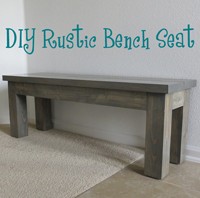
This was a test project and if this DIY rustic bench seat was successful my next project was going to be a new table for my living room made basically with the same plan.
This was going to be a “rustic” bench seat partly because you can’t get 4 x 4 lumber without knots so that dictated the lumber for the rest. Clear pine wouldn’t go with knotty legs.
I thought it odd I ended up spending almost as much on screws as I did on lumber but I used self-tapping, quality screws that were easy to put in without pre-drilling. But still, less that $40 for a big, beautiful bench? I think it’s a deal.
I wanted glued and screws construction for strength BUT I didn’t want so much as one screw showing on the outside. Exposed connectors was not the look I was going for and I have not mastered the whole pocket hole screw thing as of yet. That’s not how the bench worked out.
Gluing before screwing is assumed in all the steps as well as using clamps and other tools to ensure squareness.
I wanted a 48″ bench so it would only require buying one 2 x 8 that would be cut in half for the top – the top, or bench seat, will measure 15 by 48. Finished bench will sit 17 1/2″ high.
I wanted an inch overhang on all four sides so the assembled legs, frame, and aprons would have to measure 13 by 46.
Steps in construction
Cut legs to desired height, strap the legs together standing up on each end and use power sander to sand ends uniform and level on top and bottom
Attach spacers 3/4″ in for end aprons – make sets for each side and screw in with 2 1/2″ screws. If you make all four legs exactly the same you won’t be able to attach the apron pieces, so reverse 2.
I attached the end aprons next making sure everything was square screwing through the spacers from behind into the aprons – two 2″ screws on each end of apron piece.
Measure back of leg assembly to verify 8 1/2″ frame piece will leave 2 1/4″ open on each leg to attach front and back frames (2 x 4) and then aprons (1 x 4) or 1 1/2″ + 3/4″ = 2 1/4″.
Making sure everything is square, screw end frame pieces into legs – 2 screws through each leg with 2 1/2″ screws
The neighborhood kids thought the grain was so beautiful on the ends of the legs and were sorry it would be covered up on the finished bench. I agreed with them.
I took the coward’s approach here and cut my 2 x 8 for the seat of the bench to make sure it would be exactly 48″ before completing assembly of bottom. The 8′ board was actually 96 1/4″ so after cleaning up the ends and cutting in half I had exactly 48″ boards. Woohoo!
Making sure everything is square, screw front and back frame pieces into ends of side frames with 2 1/2″ screws.
Turn bench upside down and place brace pieces at top edge (on the floor) of frame and use 2 screws in each end to attach to frame with 2 1/2″ screws. These screws will be hidden by the apron.
Measure (mine ended up being 39 1/16th for tight fit) and cut front and back aprons and insert in place – screw from back with 2″ screws that will go through frame and into apron.
Use pocket hole screws to connect 2 48″ 2 x 8 boards in several places (this is optional).
Lay top (bench seat) down on floor making sure you have the side down that you will want to have showing on the finished bench (put on cardboard or something to prevent scratches), center base on seat – screw through 3 braces with 2 1/2″ screws, 2 screws at each end of braces.
Flip it over, sand and finish with paint or stain of your choice. At this point I didn’t have any nail hole or screw heads to cover up. That changed.
First problem encountered – warping
The boards for the bench were firmly attached by screws from the bottom through the cross braces. of course there was no way to screw from the bottom through the corners, so after a couple of days all four corners had lifted and the top was visibly warped.
Need I say how disappointed I was as I sunk 4 screws into my previously unblemished top to flatten out the warped boards? I buried the screw heads into the wood, filled, and sanded them smooth. So much for my hope to have no visible screws. My guess is an experienced woodworker would have known this wouldn’t work, that it’s the nature of pine to warp.
Next problem encountered – “corning”
I sanded the heck out of the bench with my little palm sander and it looked and felt perfectly smooth. I thought it looked gorgeous.
I used the Minwax Classic Gray stain again on this bench. After the first coat I was utterly appalled by how the bench looked. Not the color, but all the minute scratches in the wood that looked like someone had taken a highlighter to accent them. Where did they come from?
This is zoomed in and I had to up the contrast and drop the brightness of this image a lot so the scratches would show. Believe it or not, I couldn’t feel those scratches.
I ran out and looked at my palm sander that still had the last piece of sandpaper I had used on it. There were little dots on it.
Ever heard of “corning”? While it had happened to me before, I didn’t know what it was called until I researched to find out what had happened this time. When it happened to me before it was while sanding a painted surface. This was the first time on raw wood. Sanding residue has solidified into little dots stuck to the sandpaper and cut scratches into the wood.
I sanded — this time by hand since I was afraid of the palm sander – and sanded. Those stained scratches would not come out. I felt I had reached the point of the ridiculous with sanding so I added another coat of stain and the scratches faded. A third coat of stain and they were gone. The bench was just a hair darker than I would have liked, but I could definitely live with the color a whole lot easier than the scratches.
By the way — I couldn’t find a solution to corning. I was using quality sandpaper and other than change it every 30 seconds, I don’t know how to prevent it from corning. Maybe not use the palm sander, but that means a much lengthier process to hand sand.
Finishing
I put multiple coats of water based poly on. I started with the bench flipped over and did the bottom and the legs. The I put it upright and put several coats on the top. Water based poly has to be put on in extremely thin coats. I use a small plastic dish and a folded piece of microfiber towel to apply it. Wipe it on and stop — don’t go back and forth because it dries too fast. Do a lot of really thin coats to avoid runs.
I am going to switch to oil based poly for my next project and thin it with 50% mineral spirits and use the same basic technique.
I set the bench in place with the plan to not use it (hit it, bump it, put anything on it) for 30 days so the finish can cure.
I painted some crates so I could store hats and shoes under the bench (no guest closet in the house) but the jury is still out on whether I like them. Do they need casters or what? I’m not sure about the crates, but I absolutely love the bench and have already designed a table for the living room (taller and wider) and plan to start that soon.
I think the 48″ bench looks great under the 60″ coat hook shelf I made
This turned out to be a huge post. The text is details for newbies if they want to do their own shelves or you can skim through the pictures.
Right this moment I am reeling from the total beat down hanging the largest 60” shelf turned into. Don’t get me wrong. These shelves are easy and so awesome to custom fit exactly to the space you want them.
Now having made several – and I am new to woodworking – I don’t think buying a ready-made ledge or coat hook shelf is a good buy. Not when you can make them at a far more reasonable cost and have the custom height, depth, and width you need for each specific space.
My problem: no storage space
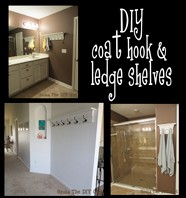
I moved into a house with no storage and most notably lacking any kind of guest closet. Where do you hang the jackets or coats you wear on a regular basis. Where do you hang jackets or coats for guests. My solution was coat hook shelves with ample hooks for hanging and a 6” deep shelf to put things like decor items.
Next came a master bathroom with no towel bar. Seriously? Where the heck are you supposed to hang towels? I solved the problem for the short-term by hanging my bath towels on the shower door, but hated how that looked. I have a beautiful shower and wanted it to show unobstructed by towels.
I kicked around the idea of doing board and batten in the entry and bathrooms since I love the look, but in the end I felt baseboards made it a deal breaker. To complete the look I would need to pull builders grade basic baseboards and replace with something more substantial and that was a financial deal breaker at this point. So my shelves would not be the nailed to the wall as the top shelf on board and batten. I would have to be able to hang them. The good part of this is they could go with me if I move.
Test project: 30” shelf by door to the garage
I made the first 30” shelf to hang by the door to the garage so I had a place for my purse, sunglasses, and jackets. It was my first project with my air compressor and nail guns. Along with my compound miter saw I couldn’t believe how quickly and easily the coat hook shelf went together.
Cost of entire project
As of this writing you can get 1” x 6” common boards for around $10, 1” x 8” common boards for around $12-13, and I paid $.80 a linear foot for basic primed baseboard. I also used boards from a shipping crate I had torn apart. I strongly encourage the use of scrap wood whenever possible.
A note about the trim you use: I know a lot of people love the more expensive crown molding. If you decide to go that route purchase your hooks (if this is to be a coat hook shelf) and measure how much clearance you need to be able to hang things on the hooks. You may have to use something larger than a 1” x 8” back board. I really like the way the simple molding looks on my shelves and don’t think it needs anything more.
I also recommend getting the hooks in advance to see how they have to be fastened. For the black hooks I wanted the holes drilled before painting so I didn’t mess up the finished shelf trying to get the hooks in straight.
If you have the paint or stain you want to use on hand, the only thing left to purchase will be some sort of hanger. I used the Ook hangman cleat for the first shelf. It’s strong and works well, but the shelf isn’t flush against the wall. So for the last 4 shelves I built I purchased keyhole fasteners. More about keyhole fasteners later.
Materials
Back board against wall 1” x 8” common pine
Top shelf larger shelves 1” x 6” common pine
Top shelf for small shelves 1” x 4” common pine
Filler board behind trim 1” x 4” crate wood
Basic trim
Oiled-bronze GlideRite hooks (I sprayed them matte black)
Brushed nickel GlideRite hooks
Hooks are potentially your biggest expense – they were slightly over half of mine. I couldn’t believe some of the prices I saw and was thrilled I could get 10 packs of hooks from GlideRite.com. I love their hardware and have used it in a kitchen update and two bathroom updates as well. It’s decent hardware that doesn’t break the piggy bank.
I had all the paint, etc on hand so I didn’t have to buy any of that.
For less than $85 I built 5 beautiful shelves with the smallest costing $8 and the largest costing $33. Couldn’t find that in a store.
Steps in construction
Glue and nail filler piece to back board taking care to not nail lower than the filler board (I glued, clamped and nailed from the back). The filler piece should be the exact same length as the back board and a little wider than the trim board you selected.
Glue and nail top shelf to filler piece and back board taking care to not shoot nails past the tops of the boards. My top boards were 4″ longer than the back board so they would overhang the back and trim.
Measure and cut trim pieces and then glue and nail in place. Use a miter saw to make the cuts for the front corners.
Caulk trim and all seams
Fill nail holes on trim and top shelf with wood filler (the remaining holes are in the back and I don’t bother filling them)
Sand entire shelve unit until smooth enough to finish
Drill holes for hooks if necessary
Install keyhole hangers
Do test install of shelf*
Finish shelves with stain or paint (I used chalk paint and clear wax)
Attach hooks making sure they are all perfectly straight
*Learn from my mistake – hang the shelves before finishing. I will go into the nightmare hanging of the 60” shelf for my entry hall later in the post. Much pain and agony could have been avoided if I would have hung the shelves before finishing.
Using leftover crate wood to fill behind trim board
Painting the shelvesAttaching the black hooks to 60″ entry shelf
Hooks I chose for entry shelf $24.95/pack of 10 and bathroom shelves $19.95/pack of 10
Keyhole fasteners
If you want a flush mount install nothing beats keyhole fasteners, but you will need a Forstner bit and chisel to install them. The keyhole fasteners themselves aren’t expensive – I got them at Lowe’s The Hillman Group 2-Count Heavy Duty Keyhole Hangers $1.38.
Before I built these last four shelves I did a lot of research and decided on keyhole hangers. They’re more work, but they are economical and an incredibly strong fastener.
To install you have to drill 3 holes with a Forstner 5/8” bit and then chisel out to create an oval hole. The center hole should be a little deeper to accommodate the screw head. I do not have a drill press and just eyeballed the depth and they all worked out fine. Yes, fine woodworkers are cringing at my total lack of precision…
Moving location of keyhole fasteners to match where studs were in the wall
I didn’t have a chisel set when I did the last four shelves, but I did when I had to move the keyhole hangers on the 60” shelf. Oh my god, I could believe how easy a chisel made it. I got my set of 4 chisels and set of 6 Forstner bits at Harbor Freight for respectively on sale for $4.99 and $9.99. Not everything at Harbor Freight is good, so be sure to read customer reviews before buying — they will tell you if it’s junk or not.
Installing shelves on the wall
For the smaller shelves that wouldn’t be holding much weight I felt hollow wall anchors would be good enough. I used these for the 3 bathroom shelves since they would only be holding towels and décor items. Just measure precisely and level and install the screws in the wall. Then hang the shelves.
For the coat hook shelves that would potentially have to support more weight or people pulling on them I wanted a firmer install. For the 30” in shelf in the kitchen that I would hang my purse and jackets on I tried an Ook hangman cleat. It’s a strong support but the shelf isn’t flush to the wall and I really like flush to the wall.
60” shelf for entry
Oh my god, what a beating. I installed the keyhole hangers an inch from each end and installed hollow wall anchors in the wall. I hung the shelf – which was a bear doing by myself since it was so long and weighs a ton. I did a gentle tug and the shelf and wall anchors ripped right out of the wall and landed (thank god) on the ladder shelf I had used to assist me so the shelf wasn’t destroyed.
Fine. I ordered the larger Ook Hangman cleat that is 18” long and is supposed to hold up to 200 pounds. My assumption is that weight limit applies if mounted into studs.
So began my search for studs. I could find studs toward the ends of where the shelf would be but nothing in the middle. What???? I thought my stud finder was screwing up so I started tapping holes into the drywall with nails. Nothing. I went to the other side of the wall and searched for studs. Nothing. In my entry there is a 30” gap with NO STUDS. Quality construction. Geez. No stud and swiss cheese drywall from my search for a stud.
The cleat had to go into studs on both ends so now what? I stood back and looked at the patched holes from the wall hangers and the nail holes from my search for studs. Dear god. Now what do I try?
The only option I could see was moving the keyhole hangers to match where I could find studs 14” from the left end of the shelf and 19 1/2 “ from the right end.
After an enormous amount of measuring and double checking and triple checking I installed the keyhole fasteners to match the studs. I put long screws deep into the studs and tried to hang the shelf. Lo and behold after all the various disasters the keyhole fasteners matched the screws and the shelf was FINALLY firmly hung on the wall. Sheesh – what a beating.
This is why I say hang your shelves before finishing. I manhandled (womanhandled) that poor shelf up and down so many times. I felt I had to drill and chisel the new holes in the house resting on carpet so I wouldn’t rip all the paint off of it and then had that mess. I had to adjust the keyhole hangers up and down multiple times to get it level – I must have been in total brain-fart mode by that time. All I can say it was a total beating for me and the poor shelf. Hang the shelf before applying the paint or finish.
‘Nuf said.
I love the shelves
36″ bathroom shelf15″ ledge shelf with hooks15″ ledge shelf with hooks – finally a good place for bath towels60″ coat hook shelf for entry30″ shelf by door to garage for everyday things
When all is said and done I love the DIY ledge shelves. I have solved the problems of coat hanging for both everyday and guests. I have a ton of places to hang things in the bathroom. And all for around $85. You can’t beat that price for five shelves that are very classy looking and functional.
While finishing my new pine ottoman tray I was faced with a predicament: The only stain I liked was Minwax Wood Finish Classic Gray 271 and the only polyurethane I had was Minwax Water Based Wipe-On Poly. I really like the poly and wanted to use the stain/poly combination on several pieces so I had to find out if it would work.
Research
I found a post on DoItYourself.com that supposedly came from Minwax. It was about floors, but I figured if it worked on floors that take so much abuse, it would work on my tray.
I received this response from Minwax…
SUBJECT: Minwax Water Based Polyurethane Over Minwax Wood Finish Stains
You may apply the Minwax Water Based Polyurethane over a fully cured Minwax Wood Finish Stain (oil-based). Please use the following guidelines:
To ensure the color fastness of Minwax Wood Finish prior to applying Minwax Water-Based Polyurethane:
1.) Allow final coat of stain to dry 8-24 hours (Dry time is affected by your ventilation, temperature, and relative humidity).
2.) Wipe down the stained surface using a soft, lint-free cloth dampened with 100% pure mineral spirits. If the stain is cured and inactive, the mineral spirits will not affect the color. You should not have any color pick-up onto the cloth. The mineral spirits will remove any active/excess stain from surface and help the stain to cure out.
3.) Allow the mineral spirits to evaporate/flash off the surface.
Once the stain color is set and cured (passed the color-fast test), apply 3 coats of the Minwax Water Based Polyurethane per label directions.
Sincerely,
Consumer Affairs
The test
I did as the post suggested — I allowed the tray to dry overnight and then used a microfiber cloth to wipe it down with mineral spirits. Again as suggested, I allowed it to “evaporate/flash” for a couple hours. My cloth had picked up just a tiny amount of color so I thought it was okay to go ahead with the poly.
Tray after “flashing” with mineral spirits
The results
The poly went on over the oil based stain beautifully. I put on 3 thin coats, of course this worked out to 6 coats since I had to do the bottom and then the top, attached the handles and am very pleased with the finished tray. The satin poly gave it a really nice finish and feels rock solid over the oil based stain.
Tray after 3 coats of poly
I will continue to use this combination of water based poly over oil — I’ll report back if I run into any problems.
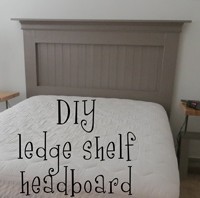
 Once I had arrived at the plan for the bedside tables I could move forward with the headboard. The open style of the tables meant I could have a large, solid headboard and it wouldn’t be too overpowering.
 I checked and double checked the height of my mattress and boxspring to make sure the leg height would be right. I wanted to wall showing (obviously) but most of that bottom board showing.