Category: Dogs

Dogs – projects for my dogs

  • Installing electric dog fence

    Installing electric dog fence

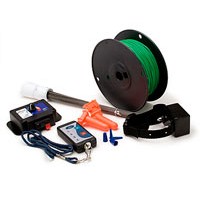
    Installing electric dog fence - TheDIYGirl.comMy dogs are trained for an electric fence. When they were puppies I purchased an Innotek Contain and Train SD-3000. Innotek has come out with much fancier systems now, but I’m still happy with what I have.

    I like Innotek — they stand behind their products. The collars are the most expensive part and if one fails (and they have) you can do a trade-in at a much lower cost than buying a new collar.

    This system also comes with an adjustable transmitter. The dog collars beep well before the dogs gets a shock. The width of that area where it gives the warning beep can be adjusted. I love this feature. My dogs hear the beep and high tail it back into safe territory.

    Previous install

    The house in Texas was an easier install for several reasons. It was a smaller yard. There were large ground cover areas that I could just run the wire through instead of burying it. But most importantly it had a concrete driveway with seams. I designed the layout for the fence incorporating one of these seams to run the wire through.

    I put all the flags out, and did a lot of training, but my girls were so good they’d never cross the line to see what happens. I hated doing it, but I had to take them across the line so they’d get zapped. One zap was all it took. Neither of them will continue when either of their collars beeps. 

    The bad part — forget taking your dog down the drive to go to the street for a walk. They would look at me with an expression that said “Uh, uh. We KNOW what happens if we walk up that way. No way we’re going.” They won’t risk getting zapped again. So I have to load them in the SUV and go to a park. Not a bad thing. Safer on paved trails anyway.

    Next install

    I brought the transmitter and collars, purchased more wire, and faced a much more difficult install. I had a lot more yard to cover and no ground cover to cheat with. I also had an asphalt drive way to cross.

    I would advise sitting down and drawing out where you want the fence to go, where you’ll access the electricity, and what obstacles you have to get around or through. The wire has to be a continuous loop for it to work.

    The transmitter is not water proof so I put it in the detached garage and drilled a hole through the wall to run it outside.

    Installing electric dog fence - TheDIYGirl.com
    Transmitter in detached garage
    Installing electric dog fence - TheDIYGirl.com
    Wires coming out of garage

    Where ever you put the transmitter you have to start there, go around the yard in a circle and return to the transmitter.

    The man who is mowing my grass (in lieu of buying a riding mower) graciously offered to loan me a gas edger, so I used it to dig a little trench all the way around the perimeter. It did a good, but not perfect job, so while burying the wire I had to do some digging in places. But all together so much better than doing it all with a shovel.

    My big dilemma was still the asphalt driveway. I figured I wasn’t the only person to face this so I started researching on the internet and found there were ways to protect the wire running over the drive. I ordered the product on the left from Amazon and it’s perfect. It’s black so it looks good on the drive and it sits over the wire and protects it from car tires. And it doesn’t slip

    Installing electric dog fence - TheDIYGirl.com
    strip across asphalt drive

    around. I’ve had it out for a few weeks and it’s staying put.

    It was a full two-day exhausting project, but it’s in and working. Most of that time was scooting along the ground cramming the wire down into the crevasse. I figured out some tools that made it a little bit easier.

    Not to worry about cutting the wire in the future. I regularly check to make sure the red light on the transmitter is lit. If it’s not it could very well mean the wire has been cut. If did anywhere near the wire, I always check to make sure I have cut the line. I’ve had line cut before and fortunately there’s a way to find the break and repair it.

    I’ve now made the same mistake on two installations. At the old house if the walked to close to the front door their collars would beep. I think it was 2 years before my younger dog would retrieve a ball from that particular corner. I apparently didn’t get the wire far enough from living room corner of the house here and if I forget to remove their collars they will get a beep in the living room. Not a good situation, so make sure you get the wire far enough from all points of the house.

    We’re all glad the fence is in

    This house is on a busy road and there’s no way I would let my dogs loose so they’d been on a leash to do their business since we moved here. I could tell they were really tired of it. They’re happy to be back on their collars and have time to leisurely sniff around the yard. I’m happy knowing they can’t end up on the road to get squished. I just have to check the batteries in their collars to make sure they’re still signalling the dogs when they’ve walked too far.

    Training

    When I first installed the fence my dogs were so good about not crossing the line that they never got zapped. I ended up dragging them each across the line so they could see what happened. One time was all it took for my Labs — they never wanted that to happen again.

    There’s an inconvenience to this type of fence. Because I had the line across the driveway, there was no way to exit the yard to go for a walk. Walks entail loading them up in the vehicle and taking them someplace to walk. Not an awful problem if there are walking paths nearby.

    An inconvenience for the dogs – squirrels figure out the dogs can only go so far and will stand just outside their perimeter and chatter at the dogs, really taunting them. I never would have guess that would happen.

  • PVC Dog Cot Tutorial

    PVC Dog Cot Tutorial

    PVC Dog Cot Tutorial - TheDIYGirl.com
    Nikki and Ellie 4-24-2005 on the first cot I made

    Update February 10, 2015 – New sizes available

    I have added instructions below for materials and cutting for medium and small PVC dog cots as well as the original large PVC dog cots. The small size looks so cute when next to the large one.

    I went to buy smaller diameter PVC for the medium and small and didn’t like the amount of flex (bending) in 1″ PVC so all 3 sizes are designed using 1 1/2″ PVC. Make the legs shorter for the smaller sizes.

    All the general instructions remain the same — just use the correct set of measurements you need for your dog.

    If you don’t sew I will be selling the slings for all three sizes so see Large, medium, and small dog cot slings for sale for details.

    Update 2/15/2015 – let me know if you need a specific size

    Sarah contacted me yesterday asking if I could help her with measurements for a dog cot that would fit inside their dog crate. Since I had done my calculations for the new medium and small size cots in Excel I was able to come up with all the measurements fairly easily. If you need a specific size, let me know and I will help if I can. Just don’t go too small since the slings get harder to put on small frames.

    Tutorial

    I had a reader request I sew one set of slings for the PVC dog cots and send them to her so she could then sew two more for her 3 dogs. I figured a step by step tutorial on how to do it might be warranted.

    This is basic sewing so anyone can do this project. All that’s required are straight rows of straight or zigzag stitches so it would be a good beginner project.

    This tutorial is based on using 1 1/2″ PVC pipe and fittings only for a 30″ by 36″ bed for a large dog.  Before making, be sure you have the floor space to accommodate the bed. If you have a smaller dog and want a smaller bed you will have to calculate different measurements. If you need help doing this you can contact me.  

    What you need for the project:

    PVC Dog Cot Tutorial - The DIY Girl

    PVC Dog Cot Tutorial - The DIY GirlPVC Dog Cot Tutorial - The DIY Girl

    The first thing you will need to track down is the elbows that will be the corners of the bed. You can find the elbows on Amazon and they are also available at US Plastics and other places. Update: when I made my first cots these 3 way elbows were not available locally. Appears the big box stores carry them now, which makes this project even easier. Note added February 21, 2017: Bob let me know he ordered the 3-way elbows on-line at Home Depot, a pack of 4 for $10.26 with free shipping to the store: 1-1/2 in. Furniture Grade PVC 3-Way Elbow in White (4-Pack) Internet #: 205749500 UPC Code: 812039024359

    3-way-elbow

    You can go to your local big box home improvement store to find 1 1/2″ pvc in 8 ft. lengths. It’s reasonably priced.Look for 3 way elbow fittings and for this tutorial they must be 1 1/2 inch. Note added February 21, 2017: Bob also thought I should specify that expensive furniture grade PVC isn’t necessary, but schedule 40 pipe is important since it’s much stronger and thicker than schedule 30. So be sure to get schedule 40 PVC pipe. Take the measurements for each side and see if they will cut the pipe for you.

    Note added February 21, 2017: Last but not least Bob mentioned rubber caps that would prevent slipping on hard floors with part information Home Depot # Model # PQC-101 Internet # 100372302 Store SKU # 688053. They are $2.97 each. He suggested they be glued to the bottom of the legs so it doesn’t harm your dog. I ran into a sliding problem and bought rubber pads for furniture legs and glued them on the legs. Either idea works well and will also protect floors.

    Cutting the PVC

    They sell PVC cutters that work amazingly well. I didn’t have one for this size PVC Dog Cot Tutorial - TheDIYGirl.comPVC so I cut the pipe with my compound miter saw. Cut the pipe into 2 32″ and 26″ pieces. When fitted into the elbows this will create a frame with the outside dimensions of 30″ by 36″.

    You will also need 4 small pieces for the legs. I recently increased the legs on mine after finding out one of my dogs has arthritis in her spine and I want to make sure she’s suspended above the floor. 4″ or 5″ legs would work fine for smaller/younger dogs.

    Fabric

    I’ve tried 100% cotton, cotton/polyester blend, and Cordura. 100% cotton stretches a lot. Cordura is exceedingly tough, but I don’t like it because it’s noisy — every time the dogs move around on their beds it’s very noisy. I like cotton/polyester the best. The cotton makes it soft for the dogs and the polyester makes it durable.

    The important thing about the fabric is that it must be over 48″ in width (you will need to cut the selvages off). The last fabric I purchased was Crosstalk Target at Joann which is a 65/35 cotton/poly blend that is 53″ wide. If it’s not on sale make sure you have one of their 40% off coupons – the coupons can be loaded on your smart phone. If you buy another fabric make sure it’s machine washable and at least 48″ wide.

    How much fabric you’ll need

    PVC Dog Cot Tutorial - The DIY Girl

    PVC Dog Cot Tutorial - TheDIYGirl.com
    Fabric layout for 2 large dog cots

    Cutting out the fabric

    These instructions are written for someone with little sewing experience, so forgive me if you are an experienced seamstress.

    Note: Cut the edge selvages off before measuring and cutting the slings.No pattern needed. I use a T-square to square up the fabric and make straight lines for cutting, marking the lines with a chalk pencil and then cut. I always buy a little more fabric than required because fabric stores often don’t cut the fabric straight. Once you square it up you can lose a couple inches, so better to be safe than sorry.

    Sewing the slings

    I recommend Gutermann thread. Cheaper threads aren’t of consistent thickness and will jamb up in thehome_logo sewing machine. Gutermann is quality thread and a dream to sew with.

    That said — you don’t need an expensive sewing machine. My expensive machine died and no longer had replacement parts available and I wasn’t in the mood to spend $1,500 to $2,000 on a machine. I purchased a cheap machine and it does just fine for basic sewing. Cheap machine = okay. Cheap thread = not okay.

    The ironing board and iron are both your friends. If you want to turn out a decent sewing project they are almost more critical than the machine you sew on.

    Sew outside hems

    PVC Dog Cot Tutorial - TheDIYGirl.com
    inch hems ironed on side of each sling

    After the panels are cut use an iron to turn 1 inch hems on the sides of the panels. You can go the further step of then folding the seam under again for the 1/2 inch hem you want in the end, but I find ironing the 1″ fold makes it easy to tuck the 1/2 inch under for the finished seam while I’m sewing — but I’ve been sewing since I was 5 years old, so the extra step of folding under the hem may be easier for those of you new to sewing.

    Sew the 4 outside hems. A single line of stitching is fine

    PVC Dog Cot Tutorial - TheDIYGirl.comfor these hems since they won’t take a lot of abuse from the dogs using the beds. The narrow slings should have a finished width of 23″ and the wider slings should be 29″.

    Sew end pockets for PVC tubing

    Use the iron to turn under a 1/2″ hem on each end of the slings.

    Fold the ends under 4″ to form the pockets and pin. Double and triple check before sewing that the finished length of the wide sling is 31 1/2″ and the finished length of the narrow sling is 37 1/2″.

    The most important thing is the finished length of each sling. If they are too long they will droop on the floor and defeat the whole purpose of the bed. If they are too short you won’t be able to assemble the bed. 

    When you are sure you have the correct length, stitch the pockets. I do three rows of stitching since these are the seams that will take the most abuse from the dogs jumping on the beds. I have two 75 lb. dogs who at times both leap on the same bed — I haven’t had a seam fail yet. The zigzag stitch is very strong, so you can use that as well. Just make sure the pocket for the PVC pipe is 6 1/2″ total or 3 1/4″ folded since the circumference of the 1 1/2″ PVC is 6″.

    Assembly

    PVC Dog Cot Tutorial - TheDIYGirl.com
    My QA department making sure I do a good job on the cot
    PVC Dog Cot Tutorial - TheDIYGirl.com
    This is what the assembled frame looks like without the slings
    PVC Dog Cot Tutorial - TheDIYGirl.com
    Final corner ready for assembly
    PVC Dog Cot Tutorial - TheDIYGirl.com
    Fully assembled dog cot

    You have your finished slings and you’ve cut the PVC pipe to the required lengths. You also have you PVC elbow for the corners and the short pieces for the legs. You are ready for assembly.

    The first three corners will be easy. If you’ve sewn the slings to the correct length, the final corner should be a pain to assemble because everything will be tight. That’s a good thing, so don’t worry. Note: as the cots get smaller they are harder to get that last corner on so the medium and small are hard, but doable. You want the fabric to be tight, so don’t get upset if it a bear to do the last corner.

    I have assembled the beds in a multitude of ways. I prefer to put the slings over the appropriate length of pipe and then added the corners. The 4th corner should be difficult to do — you may have to tilt the opening of the corner and work the pipe into it.

    Maintenance

    The beds are easy to dismantle so the slings can be run through the washing machine. The PVC can easily be wiped down as well. After washing and drying the slings just reassemble.

    If you have any questions please contact me.

    Links

    A reader named Donna and I worked out the dimensions to make a smaller cot with 1″ PVC.

  • PVC cots for dogs

    PVC cots for dogs

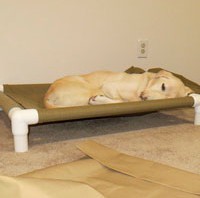
    Nikki and Ellie aren’t the first Labrador Retrievers I’ve had so I am aware of the ongoing genetic issue of hip dysplasia in their breed. I wanted my girls up off the floor with their hips cushioned.

    Both were crate trained for the first 2 years of their life — meaning if I wasn’t home they were in the crate. I loved it because I missed the whole having my home chewed phase. When they hit 2 years old the crate was removed and a cot put in its place. Since they are 2 years apart in age, that means I moved Nikki to a cot when I got Ellie because she needed to be in the crate. I couldn’t face training more than one dog at a time so I spaced them out.

    When I brought Ellie home I started building the frame and sewing the slings for Nikki’s dog cot. I bought enough materials for 4 cots — 2 downstairs where they stay when I’m gone and 2 in the bedroom for sleeping at night.  The whole time I was making the cot I was thinking I’d do all that work and they wouldn’t so much as look at it. Wrong.

    I put the first cot down in the kitchen when I was spending a lot of time remodeling it and they both climbed in. Ellie was really little at this point so they cuddled up together to nap.

    PVC cots for dogs - The DIY Girl
    1st day on new cot — they needed to include their “puppy” toy


    PVC cots for dogs - The DIY Girl
    PVC reasy to assemble
    PVC cots for dogs - The DIY Girl
    Detail of corner fittings with non-slip pads for ceramic
    PVC cots for dogs - The DIY Girl
    First sling mounted on PVC
    PVC cots for dogs - The DIY Girl
    Both slings assembled
    PVC cots for dogs - The DIY Girl
    1st corner assembled
    PVC cots for dogs - The DIY Girl
    Completely assembled cot
    PVC cots for dogs - The DIY Girl
    Level view of cot
    PVC cots for dogs - The DIY Girl
    Nikki and Ellie on current Cordura cots

    Nikki and Ellie are now 9 and 7 years old and they still love their cots.

    If you’re interested in making your own cots I can send you the dimensions I used for these. If you’d rather just put one together, email me and I can make it and ship it to you.