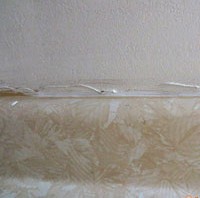
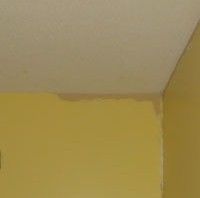
The house I’m in had a couple of screens with serious holes in them. It looked like vines had grown up and sent anchoring tendrils into the screen and someone had attempted to rip the vine off. The vine was gone and so were patches of screen.
I have replaced screening before. It’s any easy job anyone can do. You need a spline (the rubber stuff that holds the screen in the frame), a spline roller, and screen. The spline and the roller will cost you about $3 or $4 and a roll of 36″ by 25′ fiberglass screen should be around $15.
Just be careful when you’re cutting the excess screen off and don’t slice your finger like I did…
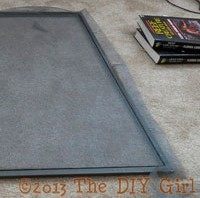
This is one of my almost completed screen — I have one side left to cut the excess screen off. You can see the books I used as a weight over to the right and the left over spline to the left.
Spline in 2 side of the screen
The screens look great and I can open the windows now 🙂
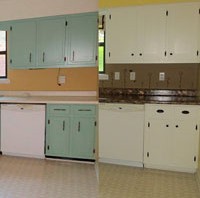
The inspiration came from the Lettered Cottage and the pictures to the left. They started with cabinets almost identical to mine so I figured I could do the same thing since I love the look of Shaker cabinets.
I knew the kitchen had to be greatly improved if I was going to sell this house for a decent amount so the cabinets had to look better. They were well-built, solid cabinets, but ugly. I wanted to keep the cabinets, but lose the ugly while not spending much money.
Many, many hours of work that required a lot of patience. This kind of project just isn’t going to be done in a day — not when you’re using a paint with a minimum 16 hour drying time and applying multiple coats.
I was able to go cheap on hardware — Overstock.com sold knobs in packs of 25 and pulls in packs of 10 at great prices. Since it needed 20 knobs and 8 pulls this worked perfectly for me. I used one of the extra knobs on a bi-fold pantry door. Some people spend hundreds on hardware. I spent $85. I wanted much improved — not exorbitantly expensive. I did have to go out and buy longer screws to put the hardware on since I had added 1/4″ to already 3/4″ doors. That was an extra six bucks.
I spent a lot more for the MDF than others on the net, especially when you factor in I had to rent a truck to get the sheets from the specialty wood store to Lowe’s where an employee cut the 4′ x 8′ sheets into strips for me. If you live in a larger city you would be able to get it much more easily and cheaper, especially if you have a pickup or van.
The primer and paint from Benjamin Moore wasn’t cheap, but when you go to this much trouble you want to end up with a surface that will last while being bumped and cleaned. What I found surprising at Benjamin Moore was how reasonably priced their supplies were — their paint trays were of much higher quality (awesome paint trays) and were cheaper than the big box improvement stores.
Item
Cost
knobs for doors and pulls for cabinet drawers from Overstock.com
50.93
Hinges for cabinets
34.27
paint supplies for kitchen cabinets, primer, deglosser – Benjamin Moore
46.91
sandpaper for cabinets
6.78
Paint for cabinets, tray, tack cloth – – Benjamin Moore
52.73
trim for above cabinets, sanding block
15.35
sanding block, misc
25.13
2×4′s for saw horses (work surface for painting cabinet doors)
17.97
rent truck to pick up MDF
21.33
2 sheets 1/4″ MDF
36.96
sawhorse brackets
18.09
liquid nails
6.75
liquid nails and white caulk
4.48
sanding block
4.89
1 1/4″ screws for knobs on cabinet doors
6.10
TOTAL FOR PROJECT
348.67
I had someone give me one of the rollers at the left and I liked it better than the wool rollers Benjamin Moore recommended because it left a smoother surface to the paint when it was rolled and then dried with a smoother finish.
Hardware and hanging
I was PAINFULLY careful while drilling the holes for the knobs and pulls. After all the work I’d put into them I did not want to screw up one of them with a hole in the wrong place. I bought a template that was useless and ended up meticulous measuring and double checking before drilling. Somebody must have been looking out for me because I got them done with no boo-boo’s.
I hate doing hinges. Five screws for each and every one and two hinges per door. I was worried about getting the doors level and even and was again meticulous in measuring before drilling for the hinges. The doors had been crooked when I took them done, so I had filled all the holes and had to start all over again when doing the hinges.
It about broke my heart but I put a couple small scratches in a couple of doors while I was hanging them. Happy to report I touched them up and you can’t tell. So far the paint is holding up really well and food stains wipe right off.
Posts of what I did
Here are links to all the posts I did along the way that provide all the gory details of each step:
The cabinets look awesome so my $350 cabinet update really paid off. I almost can’t believe I did this all by myself.
Large image of afterClose up of cabinet detailTrim I added to hide gap between cabinets and soffitI painted the inside of the doors and the face trim on the shelves so they look great when the doors are open
Finally. It took almost 2 weeks for me to get all the MDF strips done. I was working in the basement and the cool temperatures made the drying time for the Liquid Nails take forever.
I had stumbled across the original post where the paint choice and instructions had come from at Ask the Paint Gurus http://paintgurus.typepad.com/blog/2011/01/the-right-way-to-re-finish-kitchen-cabinets.html. It’s a Benjamin Moore site. It’s a good write-up and I’d recommend a read for anyone planning to paint their cabinets.
Using an old door as a work table along with my cutting table
Set up
I had saved a wooden door (I replaced a wood interior door that led to the garage with a steel door and dead bolt) for a large work surface and also used a cutting table I have for sewing. I have a room full of doors. The drawer fronts were in the bedroom to the side. I had to remove the drawer glides from the bottom so they would sit flat for painting.
The backs were already sanded so I just needed to wipe them down before painting.
I wanted to start with the backs to iron out any painting problems I might run into before doing the more visible fronts.
Priming
Primed on right and first coat of paint on left
I’m using the Fresh Start primer from Benjamin Moore and a wool roller to apply to primer. I primed the 3/8″ inset with a foam brush and rolled the backs applying only a very thin, but thorough coat of primer using the lightest touch possible with the roller.
The point of primer here is to provide a good adhesion surface between the door and the new paint. The purpose isn’t to blot out any sign of the former color. 2 coats of primer to completely cover the previous color is a waste of time. One well applied coat is all that’s needed.
When all was said and done I thought it looked a little blotchy from the roller tufts and was worried the blotches would translate to lumpy when it dried. It smoothed out fairly well when dry, but I threw out the roller. I didn’t want to risk a lumpy appearance with the paint.
I sanded the primer with a 320 sanding block and wiped the sanding dust off with a rag dipped in mineral spirits. The doors felt smooth to the touch.
Two coats of paint
Doors with second coat of paint
I switched to a different roller and still thought the paint looked a little lumpy after rolling, but this paint is incredible — it levels as it dries and by the time it had dried a few hours the alkyd paint looked really good.
Since I was working on the backs of the doors I wanted to experiment a little before doing the fronts. After rereading http://paintgurus.typepad.com/blog/2011/01/the-right-way-to-re-finish-kitchen-cabinets.html I decided to try rolling and then doing a final full length brush strokes all the way across each door (what they call back brushing) . I had basically back rolled each door on the first coat after getting the initial coverage I did slightly overlapping strokes the full length of the doors.
So far I think the back rolling with the roller gave better results than the back brushing after rolling. The doors have only been drying for 5 hours, so I’ll see how they look in the morning.
Drying time
Drying time is an issue with Benjamin Moore’s Advance paint. Since it’s an alkyd paint the standard drying time is 16 hours. Add cool temperatures and humidity and that drying time will be longer.
I let the doors dry for 2 days before flipping them over to do the fronts. I wanted the paint to be really dry so it wouldn’t stick to the wood blocks I set them on. I do not want paint to pull off when I lift the doors off the blocks.
I the doors and drawers dry for a week before hanging/replacing them since I’m working on them in a cool basement, I want to make very sure they are thoroughly dry before handling them.
I need to point out the fruit or futility of this project isn’t going to be evident until the final doors are hung from their hinges and the drawers are slid into their tracks and I can see how they look. Until then — who knows? It’s an exercise in faith. Correction — an exercise in faith by a complete novice with a minimal tools. I’m sure pros would groan over my methods.
Prep for applying strips
Drawer front hanging in frame
I built a couple of frames to assist me. For the drawers I cut sections of 2″ x 4″ and added some trashed door casing from replacing doors to hold the drawer fronts while I glued the MDF for the new fronts. That was when I got the awakening that the strips had not been cut to the requested width. The drawer strips fell a tad short of covering the original fronts.
The second frame was a small piece of 1/4″ plywood with 1″ x 1″ on two sides to hold the long edge strip in place while the glue dried. I made really, really sure the L shape was an absolute square corner (using a square) so I could trust it for keeping the strips straight for gluing.
As soon as I put the first drawer in the frame and put the strip of MDF on it I realized I had a problem. While the drawer was nice and snug in the frame, there was a gap with the MDF.
I measured the strip. My drawers are all 5 1/4″ high. The MDF was about 5 1/8″. I was depressed. I ran out to the garage and checked all the strips. Each and every strip was about 1/8″ short the width I had requested they be cut.
Too late now so I decided to have the top edge of the drawer strip even and hope the bottom wouldn’t show. The doors presented another problem. I had requested 3″ strips because that was the bare minimum to cover the holes from old cabinet pulls. I had already filled and sanded the inside holes, but hadn’t bothered with the outside since the strips would hide them. Wrong. Now I had to add the additional step of filling and sanding all the handle holes before I could apply the MDF strips to the door fronts.
Adhesive
I had researched and wanted to use Liquid Nails Paneling & Molding Adhesive – Low-VOC (LN-710). I hope it works well because I view it as a pain to use. I can barely get my caulk gun to force it out. Maybe I got old tubes or the stuff is just really thick. I can switch to painters caulk and the caulk gun is easy to use. When the first tube of Liquid Nails was gone I tried Heavy Duty and had the opposite problem. Even though I turned the caulk gun off so no pressure was being applied the tube continued to run out no matter what I tried so about half the tube ended up being wasted. This experience has left me less than impressed with Liquid Nails, but as long as the MDF strips stay attached to the cabinet doors I’ll be happy.
Extent of project
So now the extent of the project sinks in. I have to cut 7 drawer and sink fronts from the 5 1/4″ strips, and 80 door strips from the 3″ strips. 87 pieces. I don’t know about anyone else, but that’s pretty daunting to me. I don’t have a table saw so it’s cutting each one on my miter saw. I have to cut each one and glue each one. This is going to take a long time.
Drawer fronts
Obviously the one piece drawer fronts go fairly quickly — even though they aren’t quite the right size since they were cut less than the desired 5 1/4″.
Filling the routed edge
All the drawers and doors have a rounded edge from a router and the strips I’m adding are flat so there’s a gap between the strip and the original drawer or door.
I have decided I’m going for much improved, not perfect, so I’m going to use painters caulk to fill the gap between the original drawer or door and the added strips. It’s a learning experience applying the bead of caulk and I figure out that using a wet putty knife running along the strip and original edge is the best way to fill it with caulk. It gives a fairly flat edge, but I won’t know until I prime and paint everything if it’s really a good solution and will look good when the drawers are pulled out and the edge is visible.
The drawer fronts were the easy part. Next the 20 doors. With their 80 pieces. Sheesh.
Getting started on the doors
There were 8 wall cabinet doors the same height so I cut 16 26 1/2″ vertical strips. There were 8 base cabinets that needed 21 1/2″ strips that needed 2 strips each. So I cut those 32 vertical strips first. I would cut the horizontal strips as I worked on each door. The doors over the stove and refrigerator were shorter lengths and would be the last doors I would do.
Applying the strips
I start by using the frame I built to glue on the long side strips. Then door by door, I measure what’s required for the connecting horizontal strips. Might I mention here that I’m using a compound miter saw to cut all the strips and I sort of suck at exact measurements. I’m hoping this exercise will improve my skills, but for now I’m cutting them a little long and then shaving slivers off until the cross pieces fit.
This is not a fast process. I have 3 of the 20 doors done so far. Need I say more?
But I’m excited. It’s going to be a long, long process for me to do this on my own, but I’ve found it’s doable. After the glue on the door strips dries I will have to fill slight gaps between the side strips and top and bottom strips, and caulk between the routed edges of the original doors and the new flat Shaker look strips. Patience Grasshopper, patience. It’s going to take some time, but I can get it done. Then I will have 6 drawer fronts, 1 sink front, and 20 doors to prime and paint.
I have added instructions below for materials and cutting for medium and small PVC dog cots as well as the original large PVC dog cots. The small size looks so cute when next to the large one.
I went to buy smaller diameter PVC for the medium and small and didn’t like the amount of flex (bending) in 1″ PVC so all 3 sizes are designed using 1 1/2″ PVC. Make the legs shorter for the smaller sizes.
All the general instructions remain the same — just use the correct set of measurements you need for your dog.
Update 2/15/2015 – let me know if you need a specific size
Sarah contacted me yesterday asking if I could help her with measurements for a dog cot that would fit inside their dog crate. Since I had done my calculations for the new medium and small size cots in Excel I was able to come up with all the measurements fairly easily. If you need a specific size, let me know and I will help if I can. Just don’t go too small since the slings get harder to put on small frames.
Tutorial
I had a reader request I sew one set of slings for the PVC dog cots and send them to her so she could then sew two more for her 3 dogs. I figured a step by step tutorial on how to do it might be warranted.
This is basic sewing so anyone can do this project. All that’s required are straight rows of straight or zigzag stitches so it would be a good beginner project.
This tutorial is based on using 1 1/2″ PVC pipe and fittings only for a 30″ by 36″ bed for a large dog. Before making, be sure you have the floor space to accommodate the bed. If you have a smaller dog and want a smaller bed you will have to calculate different measurements. If you need help doing this you can contact me.
What you need for the project:
The first thing you will need to track down is the elbows that will be the corners of the bed. You can find the elbows on Amazon and they are also available at US Plastics and other places. Update: when I made my first cots these 3 way elbows were not available locally. Appears the big box stores carry them now, which makes this project even easier. Note added February 21, 2017: Bob let me know he ordered the 3-way elbows on-line at Home Depot, a pack of 4 for $10.26 with free shipping to the store: 1-1/2 in. Furniture Grade PVC 3-Way Elbow in White (4-Pack) Internet #: 205749500 UPC Code: 812039024359
You can go to your local big box home improvement store to find 1 1/2″ pvc in 8 ft. lengths. It’s reasonably priced.Look for 3 way elbow fittings and for this tutorial they must be 1 1/2 inch. Note added February 21, 2017: Bob also thought I should specify that expensive furniture grade PVC isn’t necessary, but schedule 40 pipe is important since it’s much stronger and thicker than schedule 30. So be sure to get schedule 40 PVC pipe. Take the measurements for each side and see if they will cut the pipe for you.
Note added February 21, 2017: Last but not least Bob mentioned rubber caps that would prevent slipping on hard floors with part information Home Depot # Model # PQC-101 Internet # 100372302 Store SKU # 688053. They are $2.97 each. He suggested they be glued to the bottom of the legs so it doesn’t harm your dog. I ran into a sliding problem and bought rubber pads for furniture legs and glued them on the legs. Either idea works well and will also protect floors.
Cutting the PVC
They sell PVC cutters that work amazingly well. I didn’t have one for this size PVC so I cut the pipe with my compound miter saw. Cut the pipe into 2 32″ and 26″ pieces. When fitted into the elbows this will create a frame with the outside dimensions of 30″ by 36″.
You will also need 4 small pieces for the legs. I recently increased the legs on mine after finding out one of my dogs has arthritis in her spine and I want to make sure she’s suspended above the floor. 4″ or 5″ legs would work fine for smaller/younger dogs.
Fabric
I’ve tried 100% cotton, cotton/polyester blend, and Cordura. 100% cotton stretches a lot. Cordura is exceedingly tough, but I don’t like it because it’s noisy — every time the dogs move around on their beds it’s very noisy. I like cotton/polyester the best. The cotton makes it soft for the dogs and the polyester makes it durable.
The important thing about the fabric is that it must be over 48″ in width (you will need to cut the selvages off). The last fabric I purchased was Crosstalk Target at Joann which is a 65/35 cotton/poly blend that is 53″ wide. If it’s not on sale make sure you have one of their 40% off coupons – the coupons can be loaded on your smart phone. If you buy another fabric make sure it’s machine washable and at least 48″ wide.
How much fabric you’ll need
Fabric layout for 2 large dog cots
Cutting out the fabric
These instructions are written for someone with little sewing experience, so forgive me if you are an experienced seamstress.
Note: Cut the edge selvages off before measuring and cutting the slings.No pattern needed. I use a T-square to square up the fabric and make straight lines for cutting, marking the lines with a chalk pencil and then cut. I always buy a little more fabric than required because fabric stores often don’t cut the fabric straight. Once you square it up you can lose a couple inches, so better to be safe than sorry.
Sewing the slings
I recommend Gutermann thread. Cheaper threads aren’t of consistent thickness and will jamb up in the sewing machine. Gutermann is quality thread and a dream to sew with.
That said — you don’t need an expensive sewing machine. My expensive machine died and no longer had replacement parts available and I wasn’t in the mood to spend $1,500 to $2,000 on a machine. I purchased a cheap machine and it does just fine for basic sewing. Cheap machine = okay. Cheap thread = not okay.
The ironing board and iron are both your friends. If you want to turn out a decent sewing project they are almost more critical than the machine you sew on.
Sew outside hems
inch hems ironed on side of each sling
After the panels are cut use an iron to turn 1 inch hems on the sides of the panels. You can go the further step of then folding the seam under again for the 1/2 inch hem you want in the end, but I find ironing the 1″ fold makes it easy to tuck the 1/2 inch under for the finished seam while I’m sewing — but I’ve been sewing since I was 5 years old, so the extra step of folding under the hem may be easier for those of you new to sewing.
Sew the 4 outside hems. A single line of stitching is fine
for these hems since they won’t take a lot of abuse from the dogs using the beds. The narrow slings should have a finished width of 23″ and the wider slings should be 29″.
Sew end pockets for PVC tubing
Use the iron to turn under a 1/2″ hem on each end of the slings.
Fold the ends under 4″ to form the pockets and pin. Double and triple check before sewing that the finished length of the wide sling is 31 1/2″ and the finished length of the narrow sling is 37 1/2″.
The most important thing is the finished length of each sling. If they are too long they will droop on the floor and defeat the whole purpose of the bed. If they are too short you won’t be able to assemble the bed.
When you are sure you have the correct length, stitch the pockets. I do three rows of stitching since these are the seams that will take the most abuse from the dogs jumping on the beds. I have two 75 lb. dogs who at times both leap on the same bed — I haven’t had a seam fail yet. The zigzag stitch is very strong, so you can use that as well. Just make sure the pocket for the PVC pipe is 6 1/2″ total or 3 1/4″ folded since the circumference of the 1 1/2″ PVC is 6″.
Assembly
My QA department making sure I do a good job on the cotThis is what the assembled frame looks like without the slingsFinal corner ready for assemblyFully assembled dog cot
You have your finished slings and you’ve cut the PVC pipe to the required lengths. You also have you PVC elbow for the corners and the short pieces for the legs. You are ready for assembly.
The first three corners will be easy. If you’ve sewn the slings to the correct length, the final corner should be a pain to assemble because everything will be tight. That’s a good thing, so don’t worry. Note: as the cots get smaller they are harder to get that last corner on so the medium and small are hard, but doable. You want the fabric to be tight, so don’t get upset if it a bear to do the last corner.
I have assembled the beds in a multitude of ways. I prefer to put the slings over the appropriate length of pipe and then added the corners. The 4th corner should be difficult to do — you may have to tilt the opening of the corner and work the pipe into it.
Maintenance
The beds are easy to dismantle so the slings can be run through the washing machine. The PVC can easily be wiped down as well. After washing and drying the slings just reassemble.
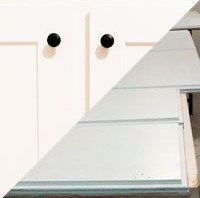
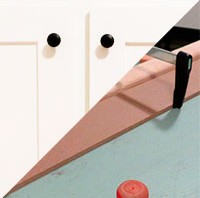
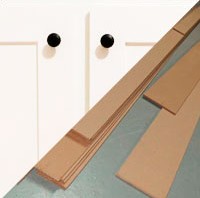
I had read a blog post from a couple who had found 1/4″ MDF at a lumber yard that also cut it into strips for them. This is what I was seeking. Do you think I could find it? Heck, no.
MDF Board
Can I tell you how sick I am of walking into my kitchen with open cabinets and no drawers? I am so ready to get this project to be completed, my kitchen totally unpacked and fully functional.
After making many phone calls for a month and a half I finally tracked down 1/4″ MDF in 4′ x 8′ sheets at A&M Supply where they graciously agreed to sell a couple of sheets to a non-commercial client — they’re a distributor. The only requirement was that the form of payment be cash or credit card and no returns allowed. No problem.
A&M did not cut product for customers so from there I started checking who was nearby who would cut the MDF for me. Many, many calls later I called the nearest Lowe’s and spoke to a man who worked in the lumber department — after I explained how long I’ve been trying to get these materials for my project he said he didn’t know what Lowe’s policy was, but I should bring it in and he would personally cut it for me. I told him I would be there the next day.
The next morning I drove to his Lowe’s to rent a truck that would hold the 4′ x 8′ sheets since my Xterra wouldn’t, then drove the truck to A&M Supply, purchased the MDF, drove back to Lowe’s, got help to unload the sheets, and then returned the truck. Sheesh. All that was a project in itself.
I got the MDF inside and found the guy who offered to cut it into strips for me and got the feeling he could be doing something he might get in trouble for. I kept telling him I didn’t want him to do something that could cause him problems. He repeatedly told me to not worry about it as he pulled the cart back to the saw.
He cut one entire sheet into the 3″ strips I needed for the doors. On the next sheet he cut three 5 1/4″ strips I needed for the drawer and sink fronts. I had him cut the remaining piece in half so it would fit in my Xterra.
He was such a sweet person. I’d like to mention his name, but on the off-chance it could cause him problems at Lowe’s I won’t do that. He hauled it all back out to my truck and helped me load it in. I told him I had to resist the urge to give him a big hug and thanked him profusely for helping me out.
After a month and a half of searching I had the materials to start converting my cabinet doors and drawer fronts to a Shaker look.
Assessing strips and changed requirements
The odyssey of materials was the good part, but when I got it all home I was confronted with the reality of the project.
I had been aware while the strips were being cut there was going to be a problem. The guy who volunteered to help my contact cut the actual strips didn’t bend over to pull the board straight across the saw and pulled each strip up toward the end of the cut. As I watched I figured the end of each board would have to be discarded. These guys were helping me out and I wasn’t about to say one word. I just upped the number of strips I’d need of each size to cover the waste at the ends.
I also wasn’t about to check the measurements of the boards. I said 3″ and 5 1/4″ and allowed them to do the cuts without any nagging. Again — these guys were helping me out. You just don’t look a gift horse in the mouth. I was thrilled to finally have the strips cut.
Measuring strips
So I get home and unload the strips. I cut the first strip for the drawer front and sensed there was a problem.
I went out and measured and the strips weren’t 5 1/4″ wide — they’re about 1/16 (or the saw blade width) short.
You know what? I’ll just deal with it. I decide the top edge of the strip should be level with the top of the drawer and allow the 1/16″ shortage to be at the bottom of the drawer where it won’t be so noticeable to user. Not what I wanted, but I would just do the best I could with what I had.
So on to the door fronts. I had asked for 3″ because it was the bare minimum the strips had to be to cover the holes from the old door handles. Guess what? The 3″ strips were also at least a 1/16″ short so at least part of the holes for the handles would show. Peachy.
I had filled the handle holes on the inside of the doors so they would look good when painted. I had not filled the holes from the outside since they would be covered by the strips.
Add another step to the process. I had to fill all the handle holes on the outside of the doors so they wouldn’t show at the edges of the strips. Just what I needed — another step.
Don’t get me wrong — I am so happy to finally have the strips and so appreciative of the man who was willing to cut them for me. It just is going to end up being more work than the project already entailed.
If you decide to do this update and have someone else cut the strips — make sure your strips are cut to the correct width or do it yourself if you have a table saw. Boy, I wish I had a table saw.
I don’t do roofs. I don’t even want to get on roofs. I can’t believe roofers do roofs. They have my respect for being tough enough to work at heights in temperature extremes year after year. They are made of far tougher stuff than I am.
Weather delays
I knew the roof was long past needing replacement when I bought this foreclosure, but have been waiting for it to stop raining and get warm enough to put a new one on.
It was supposed to be upper 40’s today (only hit 35) and in the 60’s for the next three days with sunny skies. 40’s is okay for ripping the old shingles off, but warmer weather is important for putting the new shingles on so the heat of the sun with set the shingles.
I found an absolute sweetie of a roofer who has steadfastly refused to start until he was sure I wouldn’t get rained on during the process and the temps would be warm enough for the shingles. Integrity and a good price on the roofing job. I feel very lucky to have found him.
Lessons learned
I have always been proactive about roof repairs and found out today the price of delaying. The original roof had been put on with no tar paper under it (I have never even heard of that) and was 3 to 4 years past needing replacement.
The roofer told me I was lucky in some ways — there were wet spots (we had snow the last 2 days) but he could tell the moisture had soaked into the sheeting and not gone through to be dripping on my ceilings and damaging the drywall. That’s the good part.
Because the roof wasn’t replaced when it should have been the water got into the sheeting on the roof in places and made the wood soft so they have had to tear off areas of plywood and put new down before proceeding.
Shopping for a roofer
I talked to a lot of roofers before I hired this man. He was highly recommended to me by a couple people who have lived in the area their entire lives. They were right. He’s honest, concerned about doing things right, and charges a reasonable amount.
The other estimates I got were bizarre — to the point I started wondering if I had sucker tattooed on my forehead. I checked in the the mirror and didn’t see anything. Not sure where they got the idea they could give me estimates for twice what it should cost and I would smile and say okay.
I figure this was caused by this roof replacement not being controlled by insurance. Then they would know what insurance would cover. Now there were trying to perform a little highway robbery, only I wasn’t going along.
Summary
Important things learned:
Whether covered by insurance or not, do not procrastinate about doing a needed roof replacement. The longer you wait, the more damage and the more it will cost.
Shop for roofers. Get several estimates and talk to them. It’s not just about price. It also matters that they want to do things the right way. Make sure it’s the same quality of shingle from each quote so you’re comparing apples to apples.
Be patient. Shingled roofs should have a chance to seal in warm weather when installed and that will most likely need temperatures in the 60’s.
Be prepared for the noise. Ripping off shingles and replacing them is a noisy business. It’s a little annoying for a human, but might be stressful for pets so be aware of how it’s affecting them.
Not the most exciting dollars you will ever spend on your home, but it’s the cap that protects everything that resides below it. Money well spent.
I had gone into the kitchen update fully expecting to replace the countertops so I dribbled paint on them and had no concern for them whatsoever.
So follow this with the decision to keep the countertops and paint them. Need I say I thoroughly regret my earlier lack of care that resulted in swipes and sprinkles of primer and cabinet paint?
Note to self: Don’t ever assume you’re going to discard something until it’s discarded. Take great care while you’re working on things. Better to be careful now than sorry later.
The curse of poor workmanship – again
Don’t you just love it when someone smears thick blobs of raggedy caulk around and leaves them to dry. It only takes a moment to get a wet rag and wipe the excess off.
Once again I found myself wanting to strangle the person responsible for crappy work. Someone had smeared caulk ½” to ¾” up the wall and across the top of the backsplash of the countertop. Evidently no one had instructed that person on cutting a small hole on the end of the caulk tube, minimally applying caulk, and then wiping the excess when you overdo. Sheesh.
Come on folks – even a newbie can do a decent caulk install if they wipe up with a damp rag after it’s a applied. Who did this abominable level of work?
Fixing the mess
I spent the morning with a skill knife, window scraper (razor blade), putty knife, small screwdriver, and needle nose pliers removing the caulk that was on the top of the back splash and wiped up the wall.
Caulk is a serious adhesive so removing it removed the top layers of the drywall. Whenever drywall repairs get you down to paper it’s a multi-step process to fix the drywall before it’s safe to paint it.
Sand it to remove as much loose paper as possible
Apply primer to seal the exposed paper layers and allow it to dry
Apply thin layers of drywall mud to level it and all the mud to dry
Sand the drywall until it’s smooth (I like drywall sanding screens)
Apply primer to the new drywall mud
Paint
All these steps because someone thought applying thick lines of caulk and wiping it all over the place was a bright idea.
Razorblading my paint drips off the counters: 15 minutes. Removing caulk smeared all over the place: 4 hours. You tell me – what was the stupidest move?
They also have a good tutorial on installing laminate counter tops yourself.
Decision 1: Countertops
Well I’ve made a decision about countertops. Or rather the decision was made itself for me.
I made a trip to Lowe’s to price countertops for the kitchen. Since there’s a mitered corner with one side that runs almost 12 feet the stock counter tops were not an option. They took the measurements and checked with their fabricators on cost.
The very basic waterfall edge Formica would be $370 for the counters. That didn’t seem too bad. Then they told me installation would be around $600 and tear out of the old counter would be another $200 for the installation. $370 for the material and $800 to make the change?
I’m sorry, but this isn’t rocket science. I looked underneath the counters and it’s not hard to get them off but the sink would need to be removed. That’s not that big of a deal. all the attachments would unscrew. The install is the reverse except a hole needs to be cut for the sink. How hard can that be since they should have the right tools? Put the sink back in, caulk the edges and your done. So again, my question — $800??? I figure the longest it could take would be 4 hours and I’d be willing to bet they could get the old counters out and the new one installed in under 2. So at the high estimate they get $200 an hour? I don’t think so. The problem being it’s a project I can’t do solo.
Just as a due diligence kind of thing I’m going to check with a salvage company that sells countertops, but I would imagine installation would once again kill the idea.
Giani Chocolate Brown
Another idea
Totally ticked off at the absurdity of $1200 for cheap countertops when that’s what I already have in the kitchen I started beating the internet to death on economic countertop updates. In that search I ran across a lot of painting ideas, but wasn’t really hooked on the idea until I checked Giani Granite Paint for Countertops.
I read the testimonials, but what really sold me was the long 15 minute instructional video. It was good enough I’m actually excited about painting the countertops because I think it has great possibilities. It would give them a granite look and the sealer coats would add shine.
From Giani website
I will be going with their chocolate-brown, but the color infinitely variable by how much color you do or don’t apply.
Even if it only lasts a couple of years – and there were testimonials from people who had done the painting over a year ago and the counters still looked great – at $70 and a couple of days of work it’s a bargain.
I looked at using Envirotex Lite to coat the counters and got scared off by comments that direct sunlight would cause it to yellow. With a south window over the sink and a sliding glass door in the kitchen the coating would get a lot of natural light. Beside it would be over $100 just for the top coat.
I’m going to wait until it warms up to paint the counters since the Giani instructions say it needs to be above 70 degrees for the whole process and I don’t heat the house that warm in winter months. That’s okay – I can wait.
Decision 2: Backsplash
Benjamin Moore Chalkboard Paint
After looking at a gazillion economical backsplash ideas on the internet I’ve decided to wait until the counters are painted and then go to Benjamin Moore and have their chalkboard paint tinted to a coordinating color.
Not sure where I’ll go once the chalkboard paint is up, but I’ll figure that out then.
These ideas are probably at least a month or so down the road since I want warmer weather for the counters and will be working to solve the cabinet door and drawer fronts in the meantime.
Maybe by summer I will really have the kitchen finished…
After struggling in other rooms to cover the nasty gold paint that had been sprayed in every room of the house I decided to try primer to cover it before painting. It surely couldn’t make it any worse.
I rolled primer on all the walls including the backsplash area even though I had no idea what I would end up doing with that area.
Color choice
I have to thank Jennifer at Ace Hardware. I went in undecided about what yellow to go with and she steered me to a paler shade than I was thinking. As soon as it went on the wall I knew I would have hated any shade more yellow than what I had bought. Ace, by the way, told me that I could bring the paint back if I didn’t like the color. Lowe’s and Home Depot won’t take returns when you make a bad color choice. I went with Straw and love it.
Problem area
The only problem was the corner over the stairway opening and the center of the wall along the stairs. I was able to roll it with my fiberglass extension. If you don’t have one of these, invest in one. I have used this more than I can believe and it keeps me from climbing a ladder when rolling the walls. It’s a great investment.
I COULD NOT reach the corner
I always worry when setting up my 20′ ladder in precarious places when I am working alone. I don’t want to take a header off a ladder when there’s no one around to call 911. The dogs are very caring, but their dialing skills are somewhat lacking.
You can see the area that still needs to be cut in at the back corner and the wall behind the fan.
The corner wasn’t so scary — the ladder would be firmly braced against the stairs and leaning on the wall. That wasn’t so bad.
I set up the ladder and got the corner painted as far as I could. It left about 3 feet of the center wall not cut in. You can see it in the picture to the left. Groan.
There was concrete edging in the yard and tried a couple different configurations of stacking it on one step to level the ladder with the foot resting on a higher step. Need I say I was less than enthusiastic about actually climbing up this set up all by myself?
I did it one time. The cutting in needs two coats, but there was no way I was going up that ladder a second time. I was grateful there had been no disaster on my one trip and had no intention of pushing my luck.
I located an edging pad by Mr. Longarm that I had used in the past. I still had it, but the pad had deteriorated with age and wasn’t usable. I ordered another and plan to put it on the end of my fiberglass extension and wiping on a second coat while standing firmly on the kitchen floor by the stair railing. I don’t care how it ends up looking as long as I don’t have to go up that ladder again.
More tools I used and liked
Purdy XL Cub Brush
Got this great roller pan at Benjamin Moore for $1.49
Teflon rollers
What’s left
I still need to do the cabinet doors and drawer fronts. I need to figure out what I want to do as far as counter tops. After that I will decide what I want to do with the backsplash area.
The final touch will probably be a kitchen island. There’s plenty of room for it and the additional storage space would be wonderful. The options I’m looking at are a 36″ cabinet with a counter top or getting an island from Ikea. I’ll have to get farther along and do more research.

 I have replaced screening before. It’s any easy job anyone can do. You need a spline (the rubber stuff that holds the screen in the frame), a spline roller, and screen. The spline and the roller will cost you about $3 or $4 and a roll of 36″ by 25′ fiberglass screen should be around $15.